
Introduction
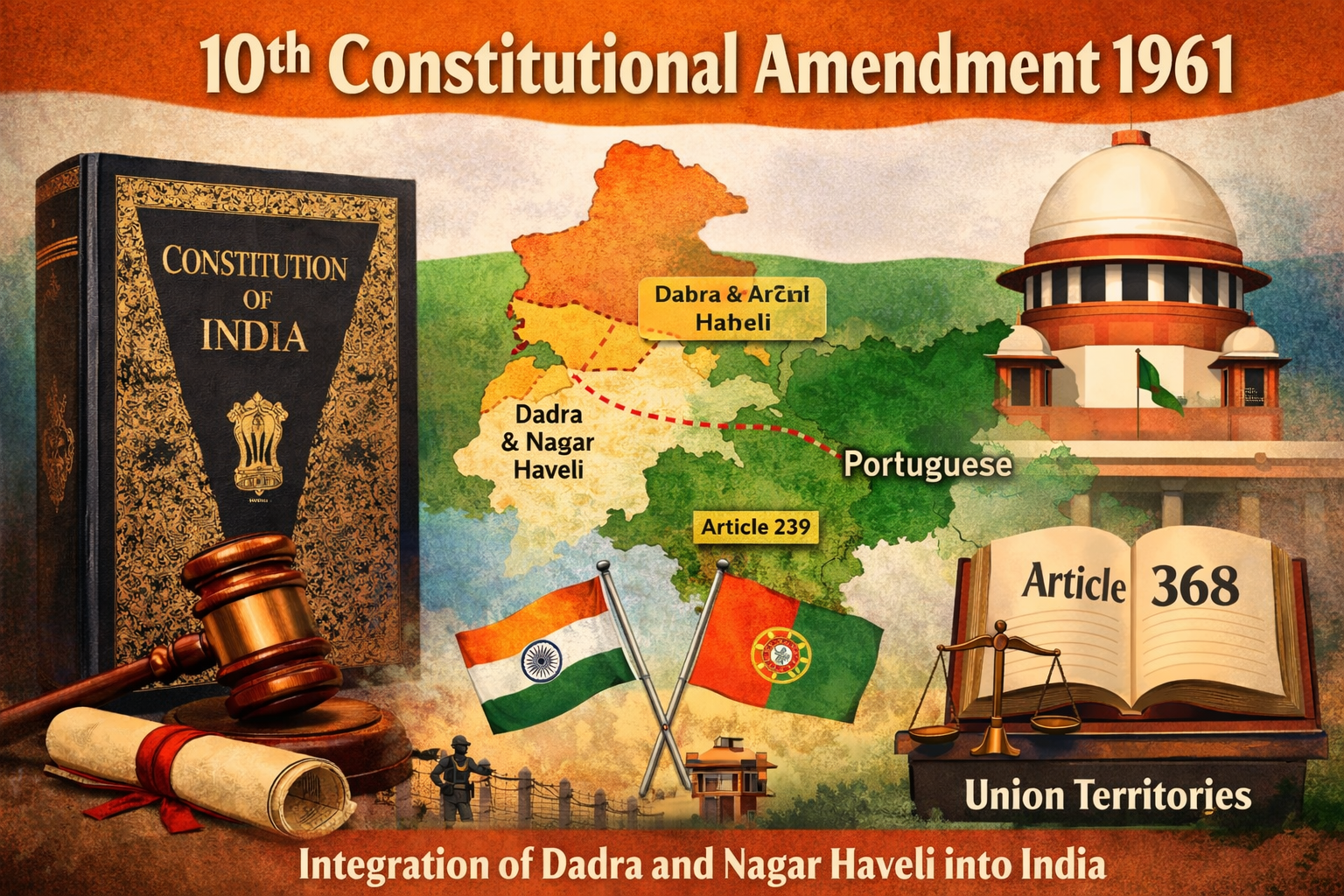
The Constitution of India has evolved through a series of amendments to accommodate changing political, territorial and administrative realities. The 10th Constitutional Amendment Act 1961 represents one such important milestone in the process of nation building and territorial integration. This amendment formally incorporated Dadra and Nagar Haveli into the Indian Union as a Union Territory. It reflects the constitutional mechanism through which newly liberated territories were integrated into the Republic of India. For aspirants of UPSC and State PSC examinations, the amendment offers insights into federal design, constitutional procedure, and the historical process of decolonization and integration.
Background and Context
After independence in 1947, India inherited a complex territorial landscape that included former princely states, British provinces and certain foreign controlled enclaves. Among these were the Portuguese territories of Dadra and Nagar Haveli, located between Maharashtra and Gujarat. Though geographically surrounded by Indian territory, these areas remained under Portuguese rule even after India became independent.
In 1954, local freedom fighters supported by nationalist groups liberated Dadra and Nagar Haveli from Portuguese administration. From 1954 to 1961, the territory was administered de facto by a local body known as the Varishta Panchayat, functioning under Indian supervision. However, its constitutional status remained unresolved.
With the larger context of decolonization and India’s efforts to end colonial rule in all parts of its territory, the Government of India initiated steps to formally integrate Dadra and Nagar Haveli. This required a constitutional amendment because Article 1 and the First Schedule of the Constitution specify the territory of India and list states and Union Territories. Thus, the 10th Constitutional Amendment Act 1961 was enacted to amend the First Schedule and include Dadra and Nagar Haveli as a Union Territory.
Current Scenario
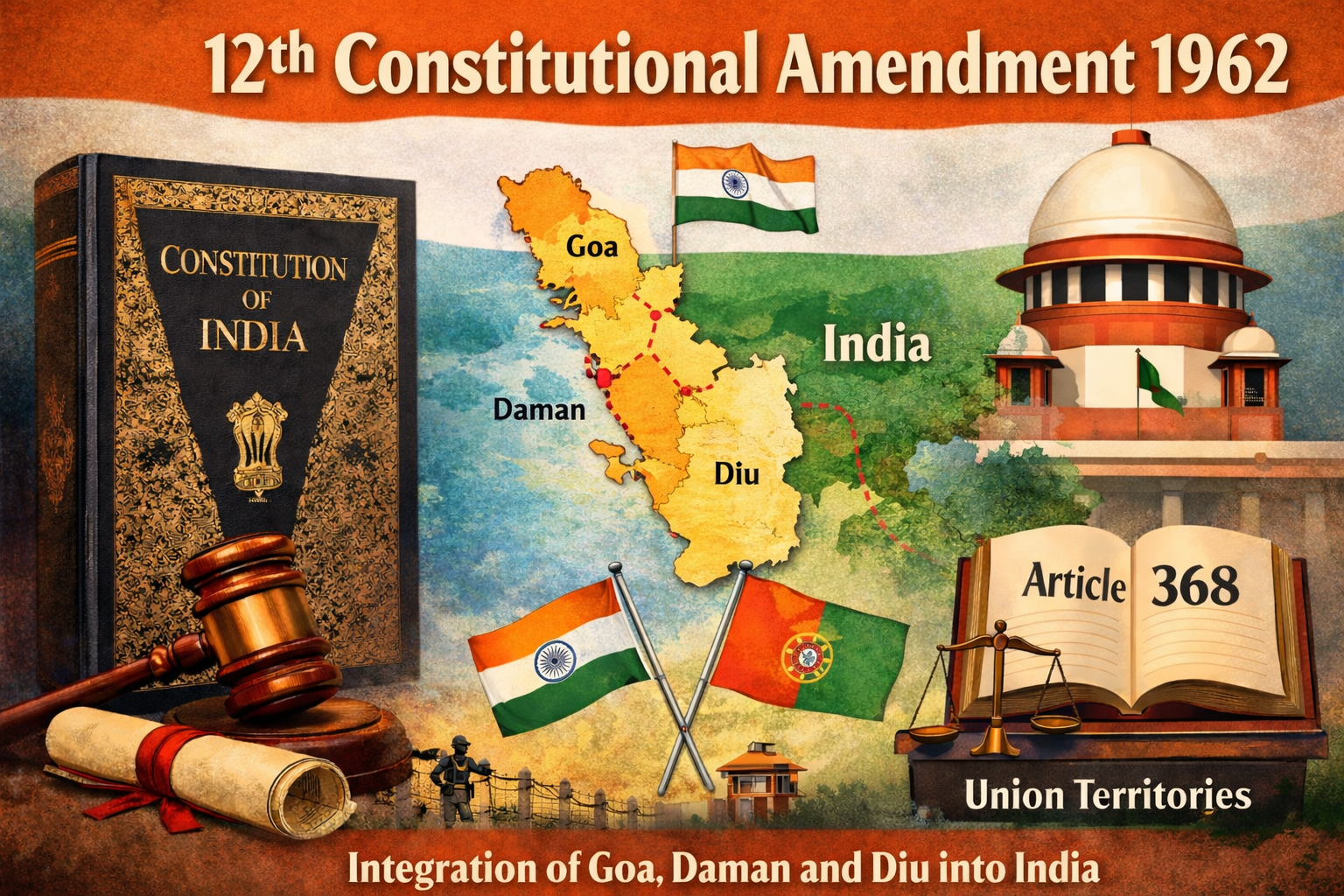
The integration of Dadra and Nagar Haveli laid the foundation for later territorial consolidations, including the liberation of Goa, Daman and Diu in December 1961 and their constitutional incorporation through subsequent amendments. In recent years, administrative restructuring has further evolved. In 2020, the Union Territories of Dadra and Nagar Haveli and Daman and Diu were merged into a single Union Territory for administrative efficiency.
Contemporary discussions in governance and media frequently highlight the importance of efficient administration in smaller Union Territories, fiscal management, and decentralization. The historical context of the 10th Amendment continues to be relevant when examining issues of territorial integration, cooperative federalism and administrative reforms.
Government Policies and Legal Provisions
The 10th Constitutional Amendment Act 1961 amended the First Schedule of the Constitution to include Dadra and Nagar Haveli as a Union Territory. This ensured its formal recognition under Article 1, which defines India as a Union of States and specifies that the territory of India comprises states, Union Territories and such other territories as may be acquired.
The constitutional mechanism for admitting or establishing new states is provided under Article 2, while Article 3 deals with formation of new states and alteration of boundaries of existing states. In the case of Dadra and Nagar Haveli, Parliament exercised its power to amend the Constitution under Article 368 to insert the territory into the First Schedule.
As a Union Territory, Dadra and Nagar Haveli was administered by an Administrator appointed by the President under Article 239. Over time, various central laws were extended to the territory to ensure uniform governance and development.
Challenges and Issues
First, administrative integration. Integrating a territory previously under foreign rule required harmonizing legal systems, revenue structures and administrative procedures with the Indian framework.
Second, socio economic development. Dadra and Nagar Haveli had limited infrastructure and industrial base at the time of integration, necessitating focused development policies.
Third, identity and representation. As a Union Territory, representation in Parliament and local self governance structures needed to be structured to ensure democratic participation.
Fourth, fiscal dependence. Smaller Union Territories often depend heavily on central grants, raising concerns about financial sustainability and autonomy.
Fifth, balancing central control and local aspirations. The Union Territory model provides direct central administration, but it must be responsive to local needs and cultural identity.
Way Forward
Strengthening cooperative federalism is essential to ensure that Union Territories receive adequate financial and administrative support while promoting local participation. Decentralized planning through Panchayati Raj institutions and urban local bodies should be encouraged.
Second, sustainable industrial and ecological development should be prioritized, especially in ecologically sensitive regions like Dadra and Nagar Haveli. Balanced growth can reduce regional disparities.
Third, continuous review of administrative structures can improve efficiency, as demonstrated by the 2020 merger for streamlined governance.
Fourth, promoting constitutional awareness among citizens in Union Territories can enhance democratic engagement and accountability.
Significance for Exams
For Prelims
1 Year of enactment 1961
2 Incorporated Dadra and Nagar Haveli into India
3 Amended the First Schedule of the Constitution
4 Related to powers under Article 1 and Article 368
5 Dadra and Nagar Haveli liberated from Portuguese rule in 1954
6 Became a Union Territory under Article 239
7 Later merged with Daman and Diu in 2020
For Mains
1 Discuss the constitutional mechanism for integration of foreign territories into India.
2 Analyze the role of Union Territories in India’s federal structure.
3 Examine challenges of administrative integration of newly acquired territories.
4 Evaluate the significance of the 10th Amendment in the context of decolonization.
5 Compare Articles 2 and 3 in light of territorial expansion.
For Interview
1 Integration of territories reflects India’s commitment to national unity and constitutionalism.
2 Union Territories serve as flexible administrative units within the federal system.
3 Decentralized governance is crucial even under central administration.
4 Territorial integration must be accompanied by socio economic development.
In Short
The 10th Constitutional Amendment Act 1961 formally integrated Dadra and Nagar Haveli into the Indian Union as a Union Territory. It amended the First Schedule and strengthened the constitutional framework for territorial integration. The amendment remains significant for understanding India’s federal design and post colonial consolidation.
Comments (0)
Leave a Comment