
Introduction
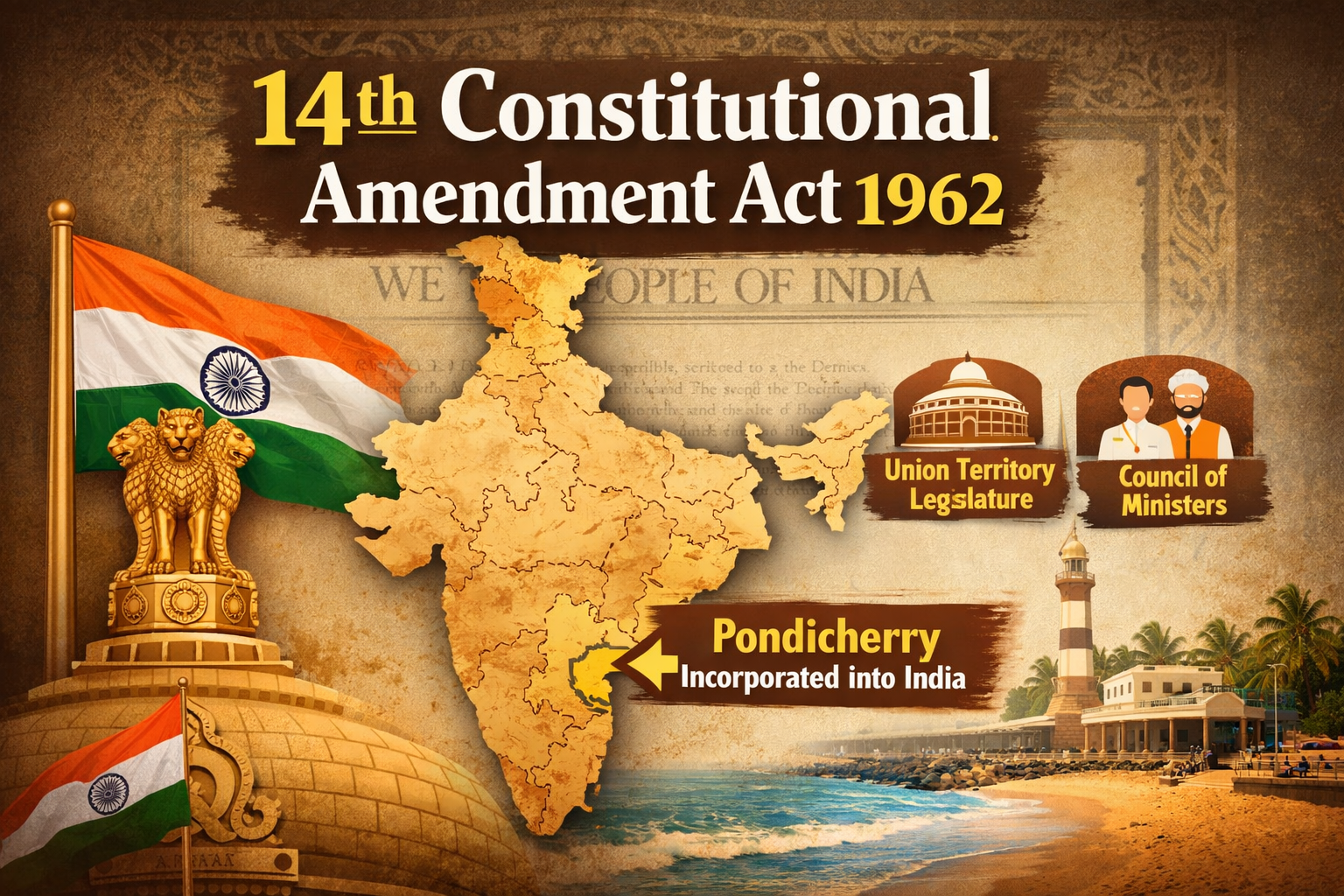
The 14th Constitutional Amendment Act 1962 was enacted to formally incorporate the Union Territory of Pondicherry into the Indian Union and to strengthen the constitutional framework governing certain Union Territories. It amended the First Schedule of the Constitution and inserted Article 239A, thereby enabling the creation of legislatures and Councils of Ministers for specified Union Territories.
The amendment was significant in India’s constitutional evolution as it reflected the flexibility of the Constitution in accommodating territorial integration and administrative reorganization. It strengthened parliamentary democracy by extending representative institutions to Union Territories and ensured institutional stability through a structured constitutional mechanism. The amendment also highlighted the dynamic nature of federalism in India, where Parliament plays a central role in shaping the governance structure of Union Territories under Article 368.
Historical Background and Constitutional Context
After independence, French settlements in India, including Pondicherry, Karaikal, Mahe and Yanam, were integrated into India. Though de facto transfer took place earlier, constitutional incorporation required amendment of the First Schedule.
Before this amendment, Union Territories were administered directly by the President through administrators under Article 239. There was no uniform provision allowing representative legislatures for Union Territories. Administrative difficulties and democratic aspirations in certain territories necessitated a constitutional mechanism for limited self governance.
The amendment inserted Article 239A, empowering Parliament to create legislatures and Councils of Ministers for certain Union Territories such as Himachal Pradesh, Manipur, Tripura, Goa, Daman and Diu and Pondicherry. This marked a shift from purely centralized administration to a hybrid governance model.
Constitutional Provisions and Legal Changes
The amendment made three major changes.
First, it amended the First Schedule to include Pondicherry as a Union Territory.
Second, it inserted Article 239A, enabling Parliament to provide by law for the creation of a legislature and Council of Ministers for specified Union Territories.
Third, it strengthened Parliament’s authority under Articles 2, 3 and 368 to reorganize territories and modify governance structures.
Pre amendment position involved direct administration under Article 239 without legislative bodies in most Union Territories. Post amendment position enabled a limited form of representative government while retaining parliamentary supremacy.
Unlike states governed under Articles 168 and 163, legislatures under Article 239A derived powers entirely from parliamentary legislation and remained structurally subordinate.
Contemporary Relevance
The amendment laid the foundation for later developments concerning Union Territories with legislatures, including evolving arrangements in territories such as Puducherry and the National Capital Territory of Delhi through subsequent constitutional amendments.
It continues to shape debates on federal balance, administrative autonomy and the scope of legislative powers in Union Territories. It also informs judicial interpretation regarding the distribution of powers between administrators and elected representatives.
Analysis from UPSC Perspective
The amendment demonstrates cooperative federalism in a graded form. It highlights asymmetrical federalism, where different territories enjoy different institutional arrangements. It reflects constitutional adaptability, parliamentary supremacy in territorial matters and the balance between democratic representation and national unity.
For UPSC aspirants, it illustrates how constitutional amendments address administrative challenges without altering the basic structure.
Challenges and Issues
Ambiguity in division of powers between administrator and Council of Ministers
Limited autonomy compared to full fledged states
Frequent political instability in small legislatures
Dependence on Parliament for structural powers
Debate over statehood versus Union Territory status
Way Forward
Clarify statutory frameworks governing Union Territories with legislatures
Ensure cooperative functioning between administrators and elected governments
Promote gradual institutional strengthening based on local needs
Enhance transparency and accountability in Union Territory governance
Balance national integration with regional democratic aspirations
Significance for Exams
For Prelims
- Year 1962, Amended First Schedule
- Inserted Article 239A
- Related to Union Territories governance
- Enabled legislatures and Councils of Ministers in certain Union Territories
- Did not confer full statehood
- Parliament retains overriding authority
For Mains
- Discuss asymmetrical federalism in India
- Examine evolution of Union Territory governance
- Critically analyze Parliament’s power under Article 239A
- Evaluate impact on democratic decentralization
- Link with debates on statehood and federal structureSimilar themes have appeared in questions on Union Territories, Article 239AA, state reorganization and federalism in UPSC and State PSC examinations.
For Interview
Explain difference between state and Union Territory governance
Discuss constitutional morality in territorial administration
Provide balanced view on demand for statehood in Union Territories
Previous Years Question Pattern Analysis
UPSC Prelims often test year of amendment, Article inserted and constitutional provisions relating to Union Territories.
Mains questions focus on federalism, asymmetrical arrangements and comparison between states and Union Territories.
State PSC examinations emphasize factual clarity regarding Article numbers and territorial reorganization.
Common traps include confusing Article 239A with Article 239AA and misidentifying the amendment number.
In Short
The 14th Constitutional Amendment Act 1962 integrated Pondicherry into India and introduced Article 239A.
It enabled legislatures in certain Union Territories.
It represents asymmetrical federalism within India’s constitutional framework.


Comments (0)
Leave a Comment