
Introduction
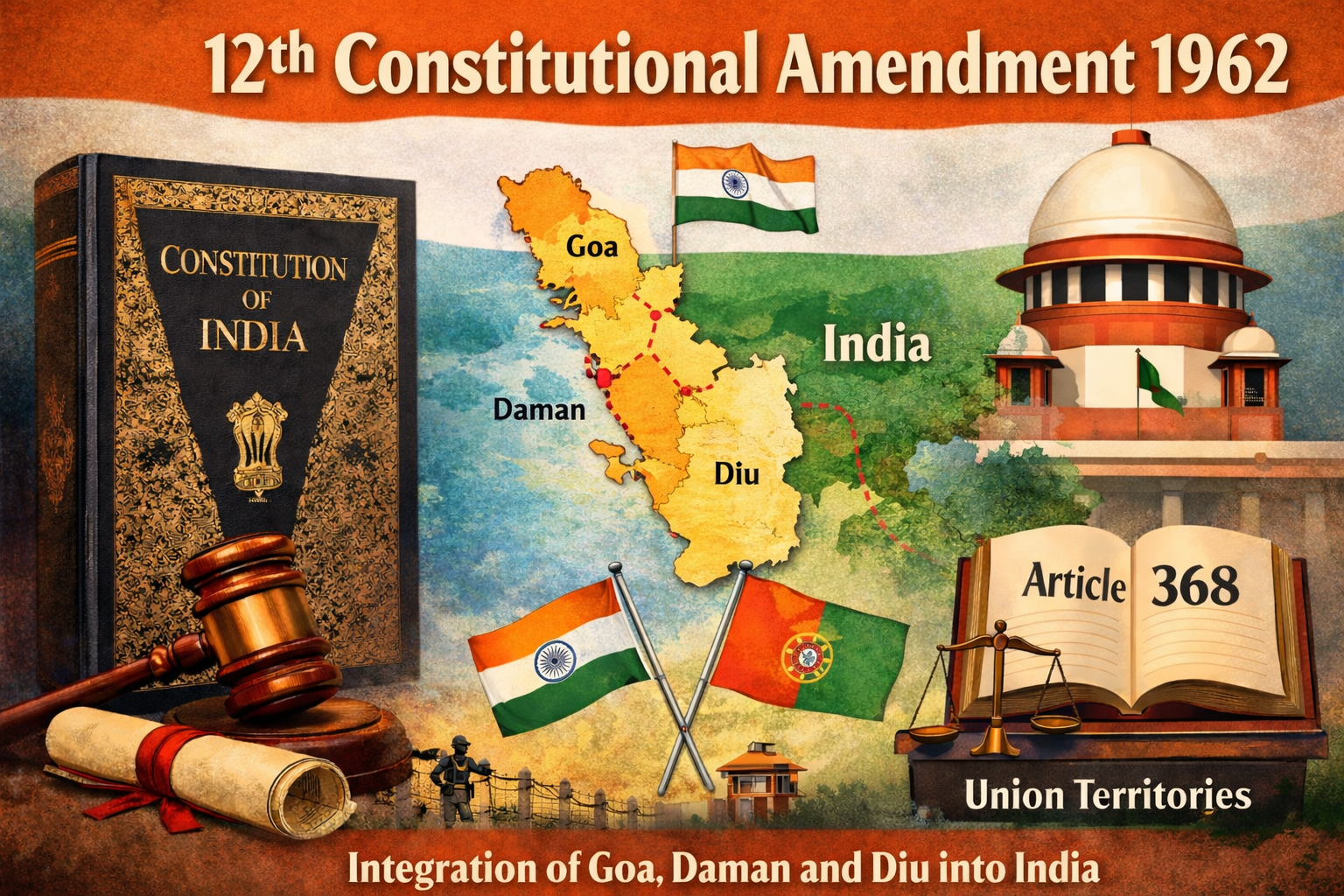
The Constitution of India has undergone several amendments to refine institutional processes and strengthen democratic functioning. The 12th Constitutional Amendment Act 1962 occupies a significant place in India’s constitutional evolution as it formally incorporated Goa, Daman and Diu into the territory of India as a Union Territory. This amendment reflects the constitutional mechanism for territorial integration and consolidation of national sovereignty after the end of colonial rule. It is closely linked with themes of parliamentary democracy, federal design and institutional stability. For aspirants of UPSC Civil Services Examination and State PSC examinations, this amendment is relevant under General Studies Paper II, particularly in the areas of constitutional development, Union Territories, federal structure and amendment procedures under Article 368.
Historical Background and Constitutional Context
After independence in 1947, most princely states acceded to India. However, certain territories such as Goa, Daman and Diu remained under Portuguese colonial rule. Despite diplomatic efforts, Portugal refused to transfer control of these territories. In December 1961, the Government of India undertook military action known as Operation Vijay, leading to the liberation of Goa, Daman and Diu from Portuguese administration.
Following liberation, the question arose regarding the constitutional status of these territories. Article 1 of the Constitution declares India as a Union of States and specifies that the territory of India comprises states, Union Territories and such other territories as may be acquired. However, any addition to the First Schedule, which lists states and Union Territories, requires constitutional amendment under Article 368.
Before the 12th Amendment, Goa, Daman and Diu were not part of the First Schedule. Therefore, Parliament enacted the 12th Constitutional Amendment Act 1962 to amend the First Schedule and include these territories as a Union Territory of India.
The amendment was largely administrative in character and did not significantly alter the federal balance. However, it reinforced the constitutional principle that acquisition or integration of new territory must be reflected formally in the Constitution.
Constitutional Provisions and Legal Changes
The 12th Constitutional Amendment Act 1962 amended the First Schedule of the Constitution to include Goa, Daman and Diu as a Union Territory. This change was made under the procedure laid down in Article 368, which requires a special majority in Parliament.
Relevant constitutional provisions include
Article 1 which defines the territory of India.
Article 2 which empowers Parliament to admit into the Union or establish new states on such terms as it thinks fit.
Article 3 which deals with formation of new states and alteration of areas, boundaries or names of existing states.
Article 368 which provides the procedure for constitutional amendment.
After the amendment, Goa, Daman and Diu were administered as a Union Territory under Article 239, through an Administrator appointed by the President. Later, in 1987, Goa was granted statehood through the 56th Constitutional Amendment Act, while Daman and Diu continued as a Union Territory.
The difference between the pre amendment and post amendment position lies in formal constitutional recognition. Before 1962, the territories were under Indian control but not constitutionally listed in the First Schedule. After the amendment, they became an integral part of the constitutional territory of India.
Contemporary Relevance
The themes raised by the 12th Amendment continue to be relevant in modern constitutional governance. Goa today functions as a full fledged state with representation in both Houses of Parliament. Daman and Diu, later merged with Dadra and Nagar Haveli in 2020, continue as a Union Territory.
Recent discussions on reorganization of states, creation of new Union Territories and changes in territorial status, such as the reorganization of Jammu and Kashmir in 2019, show that territorial integration and constitutional amendment remain dynamic aspects of Indian federalism.
The amendment also highlights the importance of ensuring that political or military actions are followed by constitutional regularization. Institutional continuity and legitimacy depend on proper constitutional incorporation.
Analysis from UPSC Perspective
From a UPSC perspective, the 12th Amendment is important for understanding the relationship between sovereignty and constitutional procedure. It demonstrates how territorial expansion or integration must be anchored in Article 368.
It also reflects the flexible yet structured nature of Indian federalism. The Union can create Union Territories and later convert them into states, as seen in the case of Goa. This links with themes of cooperative federalism and asymmetric federal arrangements.
Further, it highlights parliamentary supremacy within constitutional limits. Parliament, through special majority, formalizes territorial changes while remaining subject to constitutional procedures.
The amendment also connects with constitutional morality, as it ensures that territorial integration is carried out through lawful and transparent means rather than executive discretion alone.
Challenges and Issues
First, balancing central control and regional autonomy in newly integrated territories.
Second, the administrative transition from colonial legal systems to Indian legal and governance structures.
Third, economic integration and addressing regional disparities.
Fourth, ensuring cultural and linguistic preservation within the broader national framework.
Fifth, managing demands for statehood from Union Territories.
Sixth, ensuring that amendment procedures are not used arbitrarily but in accordance with the constitutional spirit.
Way Forward
Strengthening cooperative federalism remains essential when integrating or reorganizing territories. The Union and states must coordinate to ensure smooth administrative transition.
Institutional capacity building in newly integrated or reorganized territories should be prioritized.
Public participation and democratic representation should be expanded through local bodies and legislative institutions.
Transparent use of Article 368 ensures legitimacy and prevents constitutional disputes.
Significance for Exams
For Prelims
1 Enacted in 1962
2 Incorporated Goa, Daman and Diu into India
3 Amended the First Schedule
4 Passed under Article 368 procedure
5 Followed liberation of territories in 1961
6 Created Union Territory of Goa, Daman and Diu
7 Later Goa granted statehood in 1987
8 Linked with Articles 1, 2 and 3
9 Administered under Article 239
10 Example of territorial integration through amendment
For Mains
1 Critically examine the role of constitutional amendments in territorial integration.
2 Discuss how the 12th Amendment reflects flexibility of Indian federalism.
3 Compare Article 2 and Article 3 in context of new territories.
4 Analyze the significance of Union Territories in India’s constitutional scheme.
5 Discuss amendment procedure under Article 368 with reference to territorial changes.
6 Evaluate how statehood demands evolve from Union Territory status.
7 Link with themes of constitutional morality and democratic legitimacy.
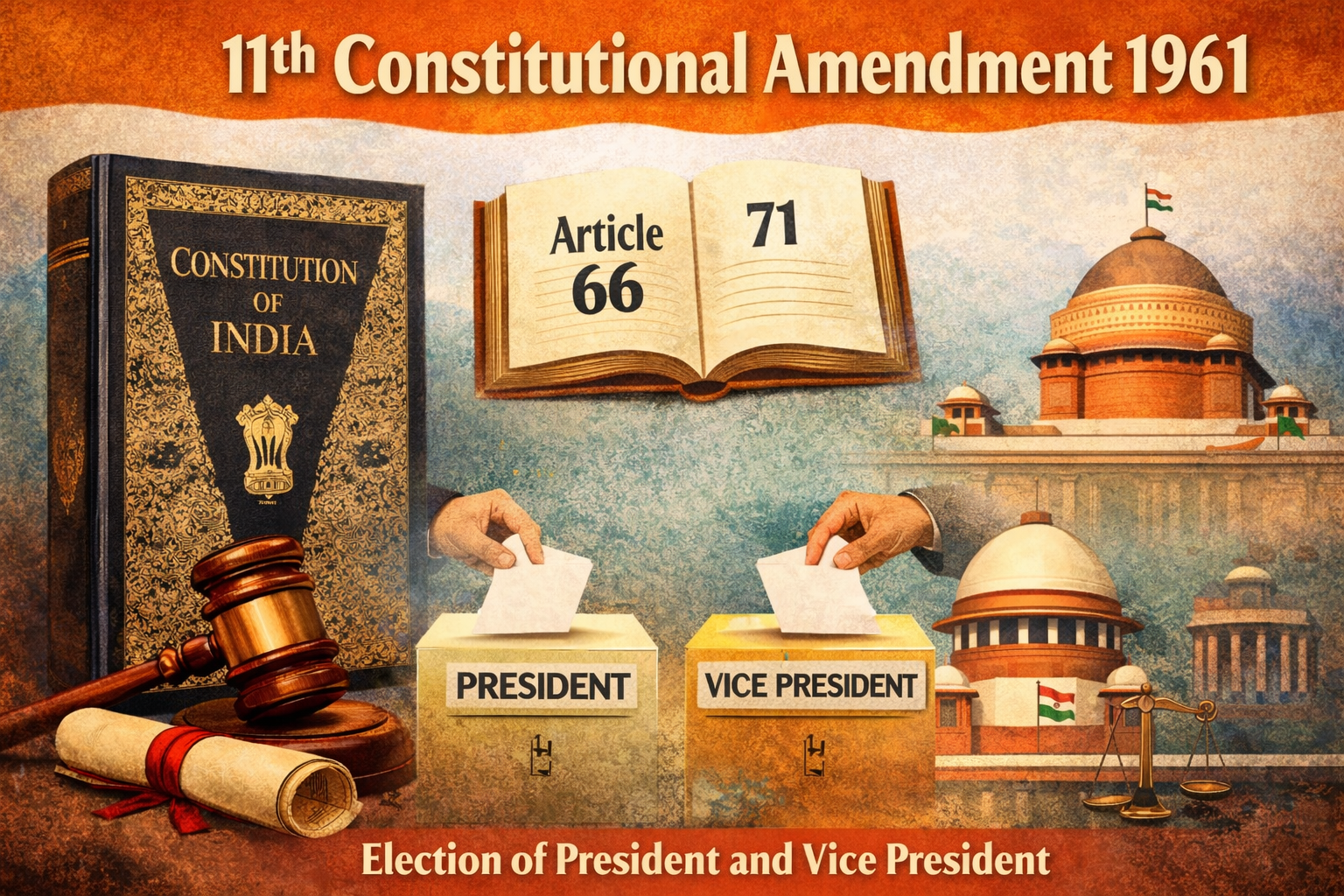
Similar themes have appeared in questions related to election of President, role of Vice President, reorganization of states, and Article 71 dispute resolution in previous examinations.
For Interview
1 Territorial integration must always be constitutionally regularized.
2 Federal flexibility strengthens national unity.
3 Democratic legitimacy depends on following amendment procedures.
4 Union Territories serve as transitional or strategic administrative units.
Previous Years Question Pattern Analysis
UPSC frames constitutional amendment questions either as factual prelims questions asking about the year, Articles amended, or the subject matter, or as analytical mains questions requiring discussion of federal implications.
State PSC examinations focus more on specific Articles, amendment numbers, and years.
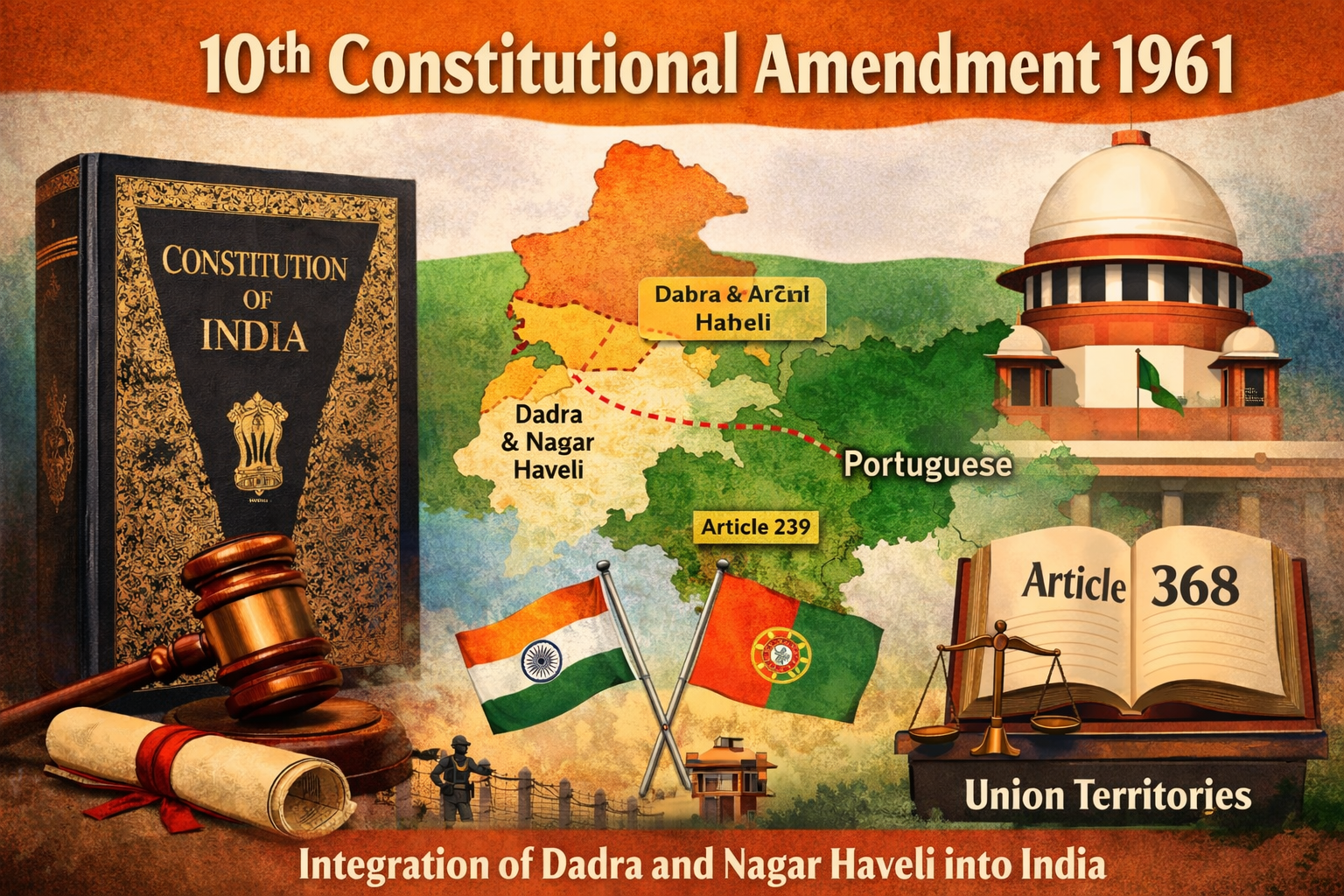
Common traps in MCQs include confusing Article 2 with Article 3, mixing up the 10th and 12th Amendments, or incorrectly stating that statehood was granted immediately in 1962.
In Short
The 12th Constitutional Amendment Act 1962 incorporated Goa, Daman and Diu into India as a Union Territory. It amended the First Schedule under Article 368. The amendment reflects constitutional consolidation of territorial sovereignty and flexibility of Indian federalism.
Comments (0)
Leave a Comment