
Introduction
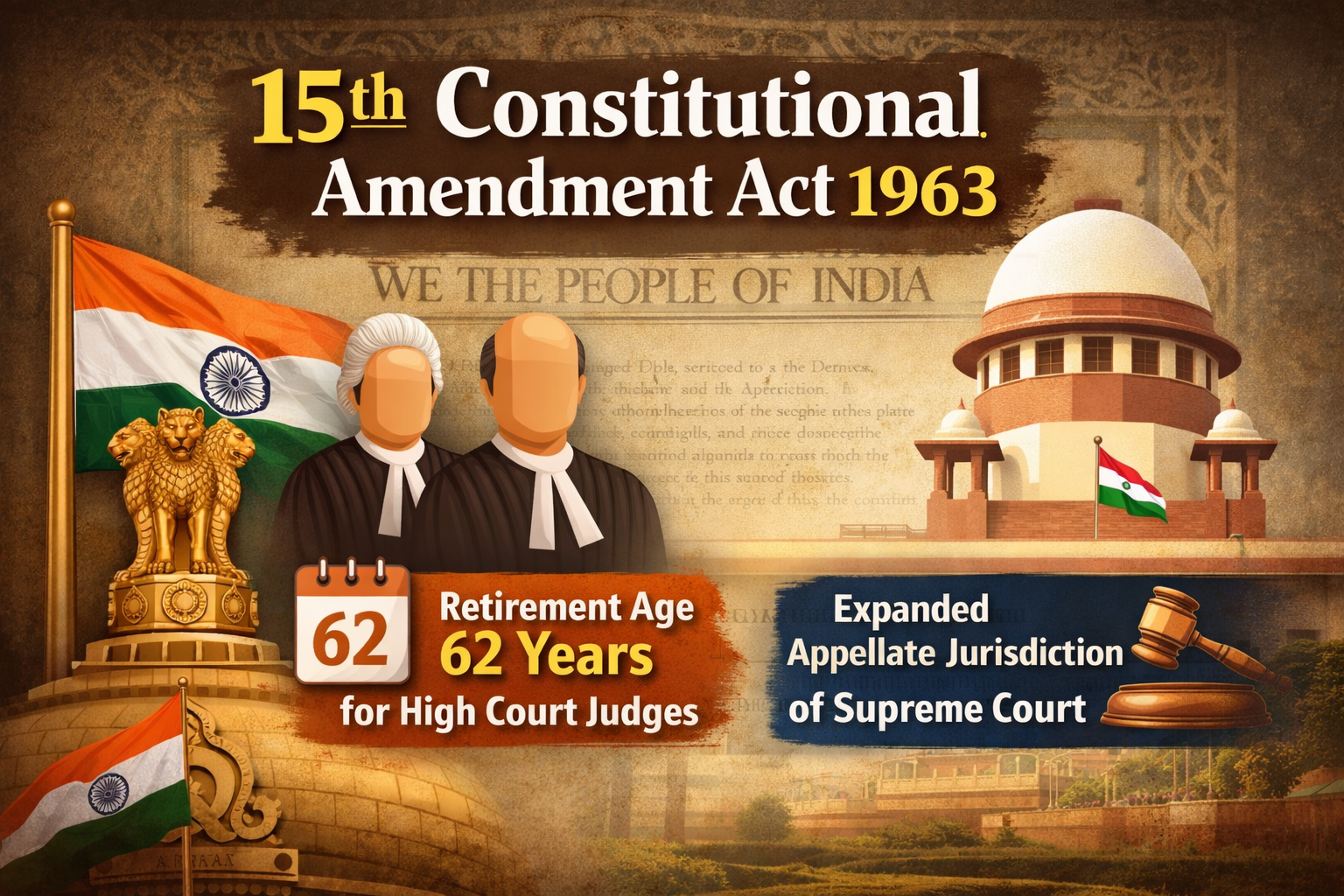
The 15th Constitutional Amendment Act 1963 was enacted to strengthen the structure and efficiency of the higher judiciary in India. It primarily dealt with increasing the retirement age of High Court judges and rationalising the appellate jurisdiction of the Supreme Court in civil matters. The purpose of the amendment was to address growing judicial workload, ensure continuity in adjudication and enhance the quality of constitutional interpretation. In the broader context of constitutional development, it reinforced institutional stability by refining judicial mechanisms without disturbing the basic structure. The amendment is significant in India’s constitutional evolution as it reflects the adaptive capacity of the Constitution under Article 368 to respond to practical governance challenges.
Background and Constitutional Context
Before the amendment, Article 217 provided that High Court judges would retire at the age of 60. With rising pendency of cases and increasing complexity of litigation, this age limit was considered inadequate for retaining experienced judges. Article 133 allowed civil appeals to the Supreme Court primarily on the basis of a monetary threshold, which restricted the Court’s focus on substantial legal questions. Administrative difficulties in managing case backlogs and ensuring uniform interpretation of law made reform necessary. Later judicial interpretations emphasised the importance of strengthening institutional independence and appellate standards, which aligned with the objectives of this amendment.
Constitutional Provisions and Legal Changes
The amendment raised the retirement age of High Court judges from 60 to 62 by modifying Article 217. It amended Article 133 by replacing the earlier pecuniary valuation test for civil appeals with the requirement of a substantial question of law of general importance. It also introduced changes in Articles 124, 128 and 222 to facilitate appointment of retired judges as ad hoc judges of the Supreme Court and to clarify provisions relating to transfer of High Court judges. Before the amendment, access to the Supreme Court in civil matters depended largely on monetary value. After the amendment, the emphasis shifted to the importance of legal principles involved. This strengthened the constitutional role of the Supreme Court in maintaining uniformity of law across the country.
Contemporary Relevance
The amendment continues to influence debates on judicial reforms, retirement age and pendency of cases. The higher retirement age supports continuity in judicial functioning and reduces sudden vacancies. The substantial question of law standard remains central to civil appellate jurisdiction and ensures that the Supreme Court focuses on issues of wider constitutional significance.
UPSC Analytical Perspective
Procedural constitutional amendments such as the 15th Amendment demonstrate how institutional refinement strengthens parliamentary democracy and rule of law. By enhancing judicial capacity, the amendment reinforces separation of powers and protects judicial review. It contributes to federal stability because High Courts and the Supreme Court form the backbone of the federal judicial structure. The amendment also reflects constitutional morality by ensuring that structural reforms are undertaken through democratic and constitutional processes rather than executive discretion.
Challenges and Issues
Despite the increase in retirement age, judicial vacancies continue to affect efficiency and access to justice.
The debate on having a uniform retirement age for High Court and Supreme Court judges remains unresolved.
Concerns occasionally arise regarding transparency and fairness in the transfer of High Court judges.
The Supreme Court continues to face a heavy caseload, raising questions about optimal appellate filtering mechanisms.
Balancing accessibility of appeals with institutional efficiency remains an ongoing policy concern.
Way Forward
Strengthening the process of judicial appointments through timely and transparent mechanisms can enhance institutional capacity. Greater coordination between High Courts and the Supreme Court may improve appellate management. Technological reforms and case management systems should be expanded to reduce pendency. Institutional reforms must remain anchored in constitutional values of independence, accountability and access to justice.
Significance for Examinations
For Prelims
The amendment was enacted in 1963.
It increased the retirement age of High Court judges to 62 years.
It amended Article 217.
It modified Article 133 regarding civil appeals.
It introduced the substantial question of law standard.
It enabled appointment of retired judges under Articles 124 and 128.
It did not change the retirement age of Supreme Court judges.
For Mains
The amendment can be analysed in terms of judicial independence and institutional efficiency. Questions may require comparison of pre and post amendment appellate standards. UPSC often frames questions using directives such as critically examine, discuss and compare in relation to judicial reforms. Recurring themes in previous examinations include independence of judiciary, appellate jurisdiction and constitutional amendments affecting institutional balance.
For Interview
One discussion point relates to the rationale behind different retirement ages for High Court and Supreme Court judges.
Another concerns balancing experience with accountability in judicial administration.
A third involves explaining the importance of substantial question of law in preserving uniformity of constitutional interpretation.
Previous Years Question Pattern Analysis
UPSC prelims generally test specific Articles amended and retirement age provisions in objective format. Mains questions require analytical evaluation of judicial reforms and institutional impact. State PSC examinations place greater emphasis on Article numbers, amendment years and precise constitutional provisions. Common MCQ traps include confusing the retirement age of High Court judges with that of Supreme Court judges or mixing provisions of different constitutional amendments.
In Short
The 15th Constitutional Amendment Act 1963 strengthened the higher judiciary.
It raised the retirement age of High Court judges to 62 years.
It rationalised the Supreme Court’s civil appellate jurisdiction by focusing on substantial questions of law.




Comments (0)
Leave a Comment