
Introduction
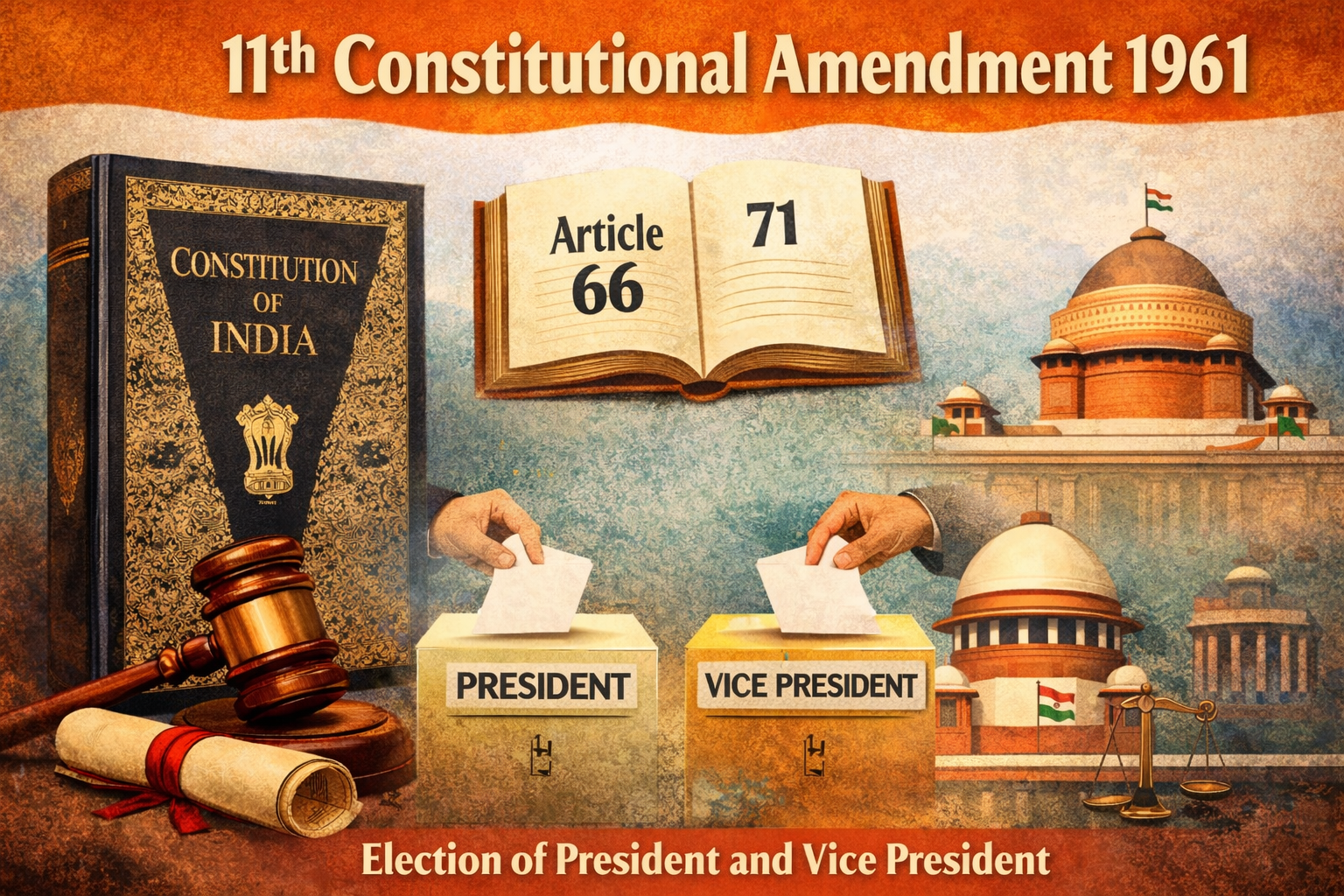
The Constitution of India establishes a detailed framework for the election of the President and the Vice President, ensuring continuity, stability and legitimacy in the highest constitutional offices of the Republic. The 11th Constitutional Amendment Act 1961 was enacted to address procedural ambiguities relating to the election of the Vice President and to clarify certain aspects of the presidential electoral process. Although relatively technical in nature, this amendment is significant for understanding the functioning of India’s parliamentary democracy and the balance between constitutional form and political practice. For aspirants of UPSC and State PSC examinations, it highlights the importance of procedural clarity in sustaining democratic institutions.
Background and Context
Under the original Constitution, Article 66 provided for the election of the Vice President by members of both Houses of Parliament assembled at a joint meeting. In practice, this raised certain procedural concerns. Conducting a joint meeting for the sole purpose of electing the Vice President was considered administratively cumbersome and unnecessary, especially when both Houses could vote without convening physically as a single body.
Additionally, questions arose regarding the validity of presidential or vice presidential elections in cases where vacancies existed in the electoral college. Since the President is elected by an electoral college consisting of elected members of both Houses of Parliament and of the Legislative Assemblies of States under Article 54, and the Vice President is elected by members of both Houses of Parliament under Article 66, any vacancy in these bodies could potentially become a ground for legal challenge.
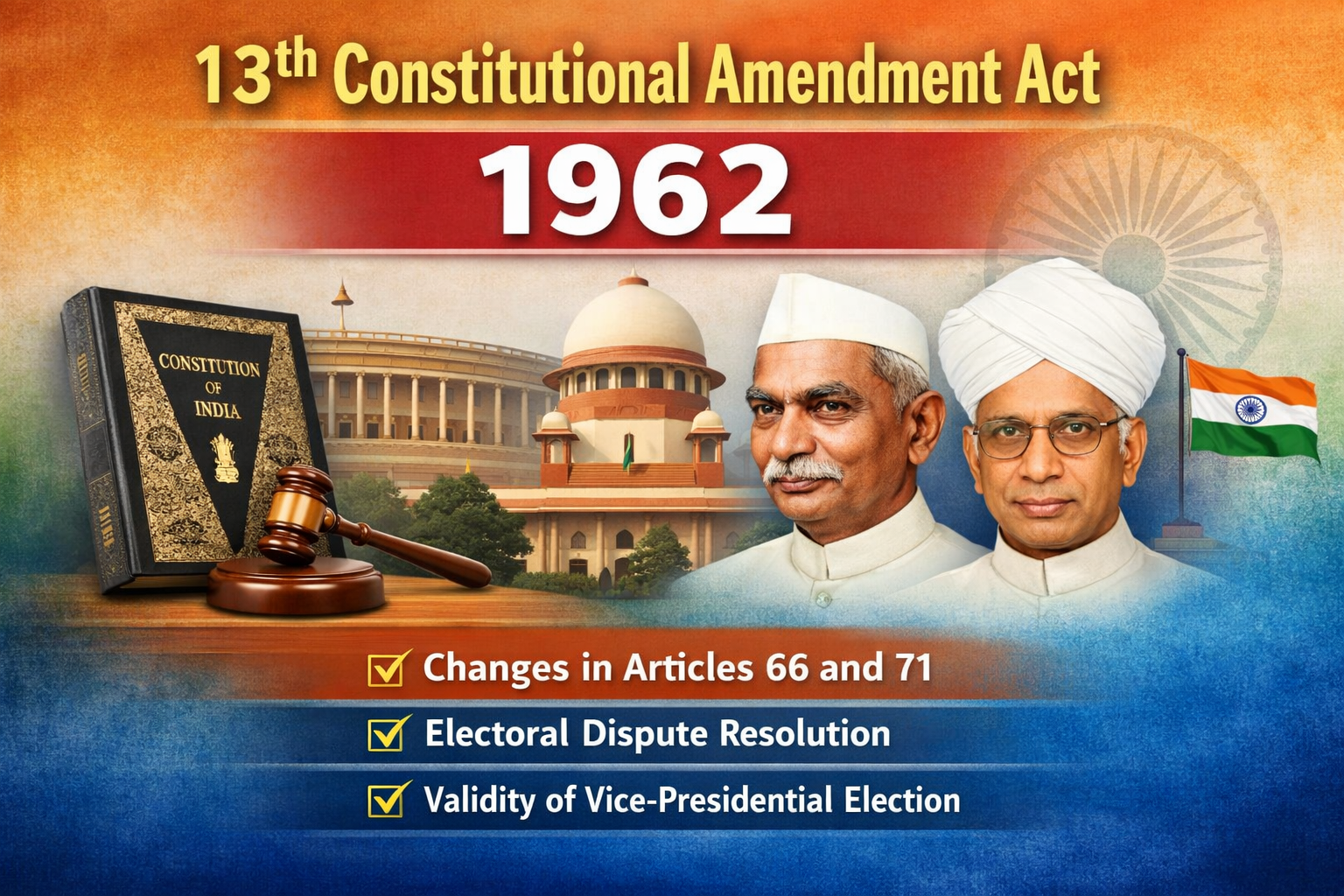
To remove these ambiguities and ensure smooth functioning, Parliament enacted the 11th Constitutional Amendment Act 1961. It amended Articles 66 and 71 to streamline the electoral process and prevent unnecessary litigation.
Current Scenario
The principles laid down by the 11th Amendment continue to guide presidential and vice presidential elections in India. In recent elections, discussions in public discourse and media coverage often emphasize the constitutional provisions governing the electoral college, voting procedures and dispute resolution mechanisms. The Election Commission of India conducts these elections in accordance with constitutional mandates and the Presidential and Vice Presidential Elections Act 1952.
The clarification introduced by the amendment, particularly that the election of the President or Vice President cannot be challenged merely on the ground of vacancy in the electoral college, ensures continuity of governance. In a large and diverse democracy, vacancies due to resignations, deaths or dissolution of legislative assemblies are common. The amendment therefore strengthens institutional resilience.
Government Policies and Legal Provisions
The 11th Constitutional Amendment Act of 1961 made two important changes.
First, it amended Article 66 to provide that the Vice President shall be elected by members of both Houses of Parliament in accordance with the system of proportional representation by means of the single transferable vote, and voting shall be by secret ballot. It removed the requirement of a joint meeting of both Houses for this purpose. This simplified the process and aligned it with practical considerations.
Second, it amended Article 71 to clarify that the election of the President or Vice President shall not be called in question on the ground of the existence of any vacancy in the electoral college. Article 71 deals with matters relating to or connected with the election of a President or Vice President, and disputes are decided by the Supreme Court.
Relevant constitutional provisions include
Article 54, which defines the electoral college for the President
Article 55 which prescribes the manner of election of the President
Article 66 which deals with election of the Vice President
Article 71 which addresses disputes regarding such elections
Article 368 which provides the procedure for constitutional amendment
These provisions together ensure that the highest constitutional offices are filled through a transparent and stable mechanism.
Challenges and Issues
First, ensuring transparency and integrity in indirect elections. Since the President and Vice President are not elected directly by the people, maintaining trust in the electoral process is essential.
Second, managing vacancies in legislative bodies. Frequent changes in membership of Parliament or State Assemblies may raise political questions, though legally clarified by the amendment.
Third, balancing ceremonial and functional roles. While largely ceremonial, the President and Vice President have important constitutional responsibilities, especially during political instability.
Fourth, judicial intervention. Election disputes are decided by the Supreme Court, which requires a careful balance between judicial review and respect for the electoral mandate.
Fifth, awareness among citizens. Many citizens are not fully aware of the constitutional procedure for these elections, leading to misconceptions.
Way Forward
Strengthening institutional transparency through timely publication of electoral rolls and procedures can enhance public confidence. The Election Commission should continue to ensure strict adherence to the constitutional and statutory framework.
Second, civic education initiatives can improve understanding of indirect elections and their rationale within a parliamentary system.
Third, ensuring smooth coordination between Parliament and State Legislatures can minimize uncertainties related to vacancies.
Fourth, periodic review of election laws in light of technological and administrative advancements can further strengthen the process while respecting constitutional boundaries.
Significance for Exams
For Prelims
1 Year of enactment 1961
2 Amended Articles 66 and 71
3 Removed requirement of joint meeting of both Houses for Vice Presidential election
4 Clarified that vacancy in electoral college does not invalidate election
5 President elected under Article 54
6 Vice President elected under Article 66
7 Disputes decided by Supreme Court under Article 71
For Mains
1 Analyze the significance of the 11th Constitutional Amendment in strengthening electoral stability.
2 Discuss the constitutional framework governing election of President and Vice President.
3 Evaluate the role of indirect elections in a parliamentary democracy.
4 Examine how constitutional amendments address procedural gaps.
5 Discuss the role of the Supreme Court in resolving presidential election disputes.
For Interview
1 Procedural clarity enhances democratic legitimacy.
2 Indirect elections reflect the federal and parliamentary character of the Constitution.
3 Constitutional amendments often address practical governance challenges.
4 Stability of top constitutional offices is essential for political continuity.
In Short
The 11th Constitutional Amendment Act 1961 streamlined the election of the Vice President and clarified that vacancies in the electoral college do not invalidate presidential or vice presidential elections. It strengthened procedural clarity and ensured continuity in India’s highest constitutional offices.
Comments (0)
Leave a Comment