
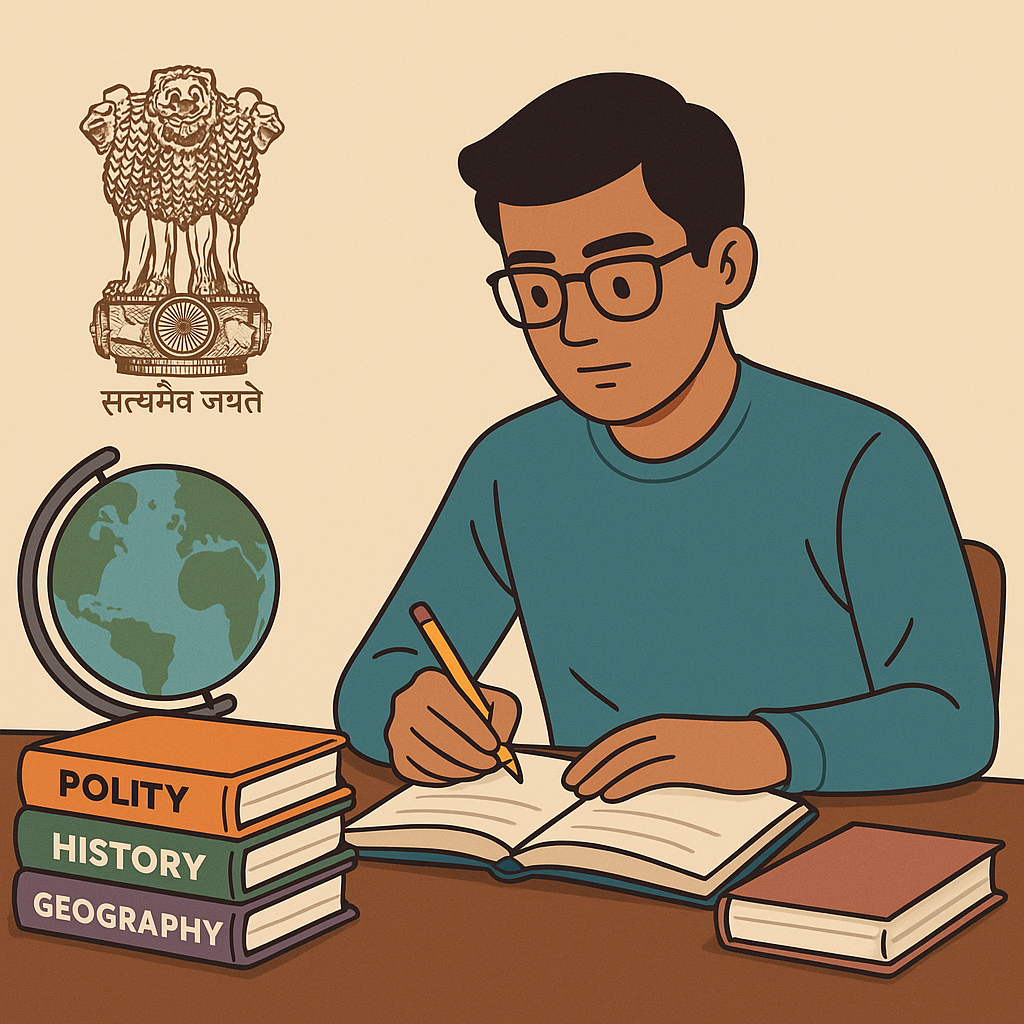
A. Understand the Nature of the Exam
The Civil Services Examination (CSE) conducted by UPSC or
State Public Service Commissions (PCS) is not just a test of knowledge — it
tests your understanding, analytical ability, decision-making, and consistency.
It has three stages:
- Prelims
(Objective) – Screening test
- Mains
(Descriptive) – Written exam
- Interview
(Personality Test) – Final stage
B. Ideal Timeline and Study Plan
1. Foundation Phase (0–4 Months)
- Understand
the syllabus and previous year papers in depth.
- Read NCERTs
(Class 6–12) for History, Geography, Polity, Economics, and
Environment.
- Begin
with standard books (like Laxmikanth for Polity, Spectrum for Modern
History).
- Make
short notes and focus on conceptual clarity.
2. Core Phase (5–10 Months)
- Start advanced
sources (Shankar IAS for Environment, Ramesh Singh for Economy, etc.).
- Read The
Hindu / Indian Express daily for current affairs.
- Join monthly
current affairs compilations (Vision IAS / ForumIAS / Drishti).
- Practice
MCQs daily from reliable test series.
- Start
answer writing (2 questions daily for Mains).
3. Revision & Practice Phase (10–12 Months)
- Revise
static subjects at least 3–4 times.
- Attempt
Prelims Test Series weekly.
- Write Full-Length
Mains Tests after Prelims.
- Practice
Essay Writing and Ethics Case Studies regularly.
C. Subject-Wise Booklist (Compact & Effective)
|
Subject |
Recommended
Book |
|
Polity |
M. Laxmikanth |
|
History
(Modern) |
Spectrum by
Rajiv Ahir |
|
Ancient &
Medieval |
Old NCERTs
(RS Sharma, Satish Chandra) |
|
Geography |
NCERT + GC
Leong |
|
Economy |
NCERT +
Sanjeev Verma / Ramesh Singh |
|
Environment |
Shankar IAS
Book |
|
Science &
Tech |
NCERT + PIB +
Current Affairs |
|
Current
Affairs |
The Hindu /
Indian Express + Monthly Magazines |
|
Ethics
(GS-IV) |
Lexicon /
Subbarao |
|
Essay |
Vision IAS
compilations + Yojana insights |
D. Optional Subject Strategy
- Choose
an optional based on interest, overlap with GS, and availability of
material.
- Read 2
toppers’ copies of your optional before finalizing it.
- Prepare
optional for at least 6–8 months thoroughly.
E. Daily Routine (Ideal Example)
- Morning
(6 am – 10 am): Core Subject Study (like Polity / History)
- 10
am – 12 pm: Revision + Notes Making
- 1
pm – 3 pm: Optional Subject
- 4
pm – 6 pm: Current Affairs Reading + Editorials
- 7
pm – 9 pm: Practice MCQs or Mains Answer Writing
- 10
pm – 11 pm: Short Revision / Mind Maps
F. Key Success Factors
- Consistency
matters more than number of study hours.
- Revision
is the most important part of preparation.
- Don’t
collect too many sources — revise limited material repeatedly.
- Practice
previous year UPSC papers regularly.
- Balance
between static subjects and current affairs.
- Maintain
physical and mental health (walk, yoga, meditation).
- Regularly
write answers — UPSC rewards clarity and structure.
G. Avoid These Mistakes
- Changing
books frequently.
- Ignoring
revision and test practice.
- Studying
current affairs without syllabus linkage.
- Copying
toppers blindly without self-analysis.
H. In Short
Civil Services preparation is a test of discipline,
consistency, and understanding — not just memory.
Follow a clear plan: NCERT → Standard Books → Revision → Tests → Answer
Writing.
With 12–15 months of focused effort, any sincere aspirant can clear this exam.
Comments (0)
Leave a Comment