
Introduction
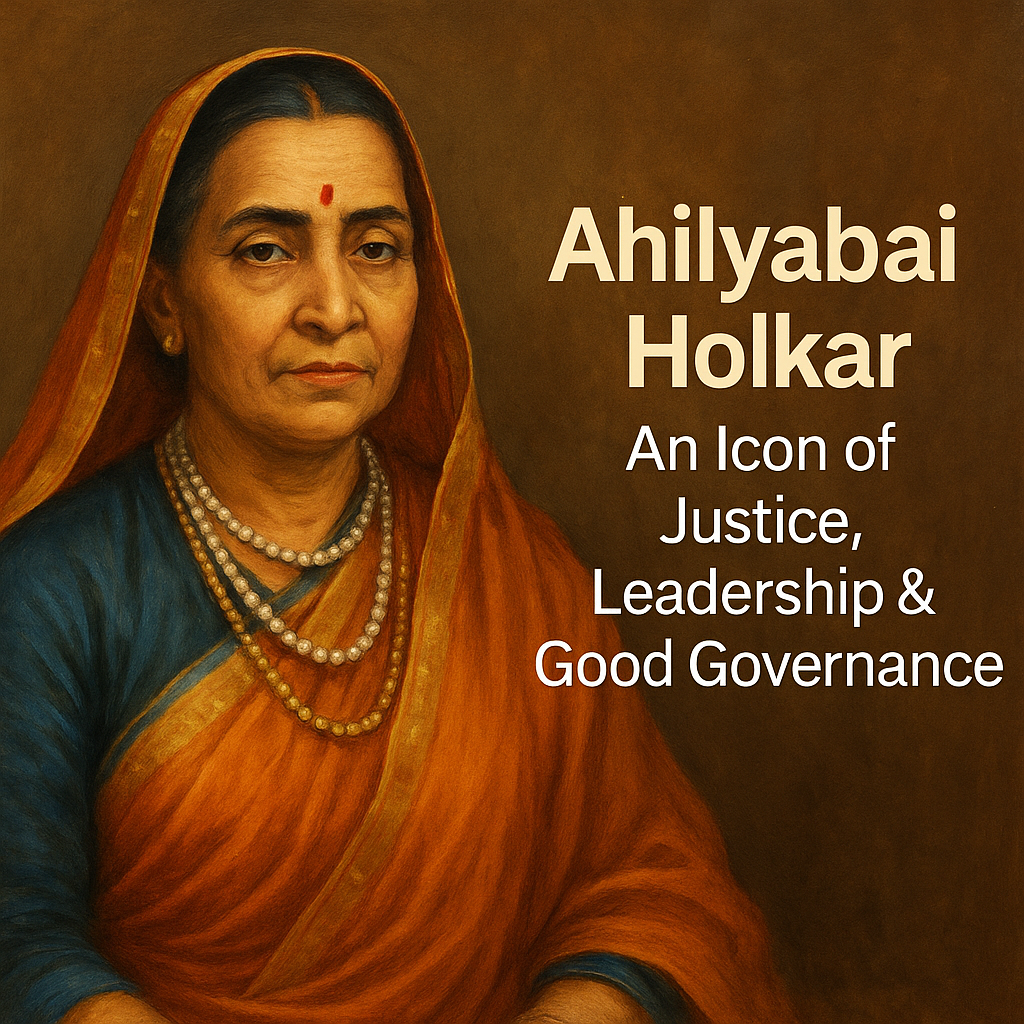
In Indian history, very few women have left such a
remarkable legacy in governance, social reform, and culture as Ahilyabai
Holkar (1725–1795). She is remembered for her just administration,
efficient governance, and contributions to religion and culture. Questions
related to her often appear in UPSC Mains and State PSC Mains, especially on
topics such as women’s leadership, good governance, and social reform.
Life Overview
- Born:
31 May 1725, in village Chaundi (Maharashtra)
- Marriage:
To Khanderao Holkar, son of Malharrao Holkar
- Assumed
power: Took charge of Indore’s administration after the death of her
husband in 1754 and father-in-law in 1766.
- Death:
13 August 1795, Indore.
Administrative Contributions
- Ideal
of Good Governance: Treated her subjects as family, earning the image
of a “motherly ruler.”
- Anti-Corruption:
Ensured strict control over corruption and maintained transparency.
- Economic
Policies:
- Simplified
and fair tax system.
- Promoted
agriculture and farmer welfare.
- Encouraged
trade and commerce.
- Justice:
Known as the “embodiment of justice,” she delivered quick and impartial
judgments.
Social and Religious Contributions
- Religious
Tolerance: Treated all religions with equal respect.
- Temple
and Pilgrimage Reconstruction: Rebuilt several sacred sites including
Kashi, Gaya, Somnath, Ujjain, Dwarka, and Haridwar.
- Her
most famous contribution was the reconstruction of the Kashi
Vishwanath Temple (1777).
- Cultural
Preservation: Built temples, dharmashalas, wells, and tanks for public
welfare.
Symbol of Women’s Empowerment
- At a
time when women had little role in governance, Ahilyabai proved that women
could be capable rulers and administrators.
- Her
reign is regarded as an ideal of female leadership in Indian
history.
UPSC/PSC Exam Relevance
Possible Questions:
- Why is
Ahilyabai Holkar’s reign considered ideal in Maratha history?
- Evaluate
her administrative and religious contributions in the 18th century.
- Discuss
her role in the tradition of women’s leadership in Indian history.
Answer-Writing Tips:
- Begin
with her biography and historical context.
- In the
body, focus on administrative, social, and religious contributions.
- Conclude
with her as a “motherly ruler and ideal administrator.”
Conclusion
Ahilyabai Holkar was not just a ruler but a symbol of justice, compassion, and good governance. She demonstrated that Indian women were not only sources of inspiration but also administrative ideals. For UPSC and PSC aspirants, her study enriches understanding of women’s leadership, governance, and Indian culture.
Comments (0)
Leave a Comment