
Background
After India’s independence, the country was divided into various types of administrative units known as Part A, Part B, Part C, and Part D states. This classification was based on historical and political factors, especially the integration of princely states and former provinces. However, this complex system created administrative confusion and inequality among different regions.
The need for a more rational and unified administrative structure was widely felt. The Government of India, therefore, constituted the States Reorganisation Commission in 1953 under the chairmanship of Fazl Ali, with members K M Panikkar and H N Kunzru. The commission recommended reorganisation of states mainly on linguistic basis.
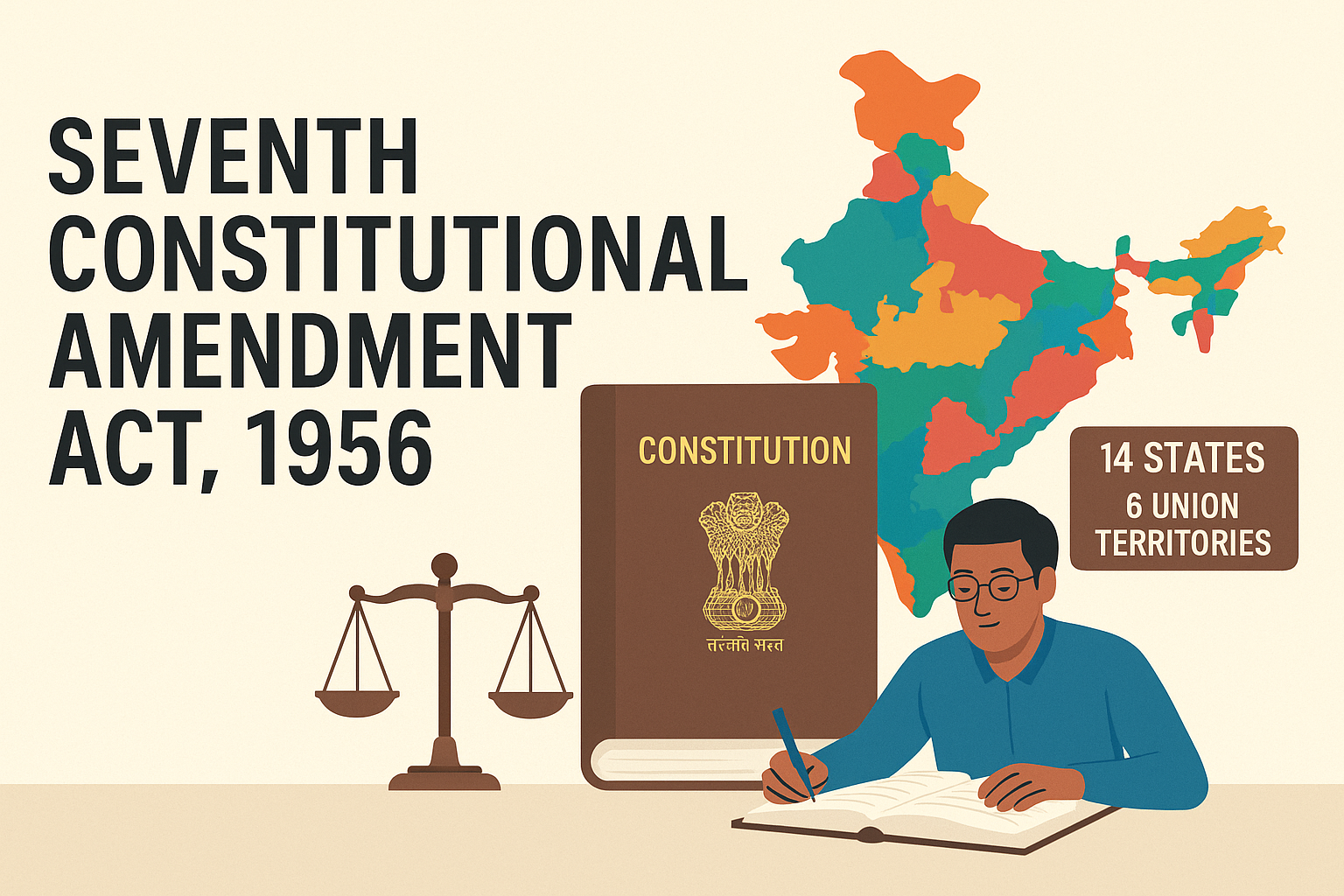
To implement these recommendations, the Constitution (Seventh Amendment) Act 1956 was enacted. It brought major structural changes to the Indian Union by reorganizing the boundaries of states and abolishing the earlier classification of Part A, B, C, and D states.
Important Facts for Prelims Exams
- Year of enactment: 1956
- President: Dr. Rajendra Prasad
- Prime Minister: Pt. Jawaharlal Nehru
- Based on recommendations of the States Reorganisation Commission (1953)
- Major outcome: Formation of 14 states and 6 Union Territories
- Repealed classification of states into Part A, B, C, and D
- Introduced a new framework for Union Territories
- Amended the First, Fourth, and Seventh Schedules of the Constitution
- Modified Articles 1 to 4 of the Constitution
Main Provisions and Key Facts
- Reorganisation
of States
The Act restructured the states of India based mainly on linguistic and administrative convenience. It created 14 states and 6 Union Territories, promoting unity and administrative efficiency. - Abolition
of Part A, B, C, and D classification
Earlier, states were divided as follows: - Part A: Former Governors’ Provinces
- Part B: Former Princely States
- Part C: Chief Commissioners’ Provinces
- Part
D: Andaman and Nicobar Islands
The Seventh Amendment abolished this complex classification, giving equal constitutional status to all states. - Changes
in Article 1
Article 1 was amended to redefine India as “a Union of States” comprising States and Union Territories. - Changes
in the First Schedule
The First Schedule of the Constitution was amended to reflect the new names, boundaries, and territories of states and Union Territories. - Changes
in the Seventh Schedule
The amendment brought changes in the allocation of powers between the Union and States by modifying the Seventh Schedule to align with the new administrative structure. - New
System of High Courts
The amendment allowed the establishment of common High Courts for two or more states and Union Territories. This promoted judicial efficiency and reduced administrative burden. - Union
Territories Administration
The Act introduced a uniform system for governing Union Territories under the direct control of the President of India. - Impact
on All India Services
The amendment provided provisions for common services, such as the creation of common cadres like the Indian Administrative Service (IAS) and Indian Police Service (IPS), to serve across states and Union Territories.
Significance
- Established a uniform administrative framework throughout India.
- Promoted linguistic and cultural unity by reorganizing states on linguistic basis.
- Strengthened the concept of Indian federalism with equal status for all states.
- Removed confusion and inequality created by earlier state categories.
- Facilitated better governance, coordination, and policy implementation across the country.
- Laid the foundation for subsequent constitutional and administrative reforms.
Criticism or Limitations
- Although it promoted linguistic unity, some regions still felt excluded or dissatisfied.
- States like Bombay and Punjab witnessed agitation for further reorganisation, leading to later amendments.
- Linguistic reorganisation sometimes gave rise to regionalism and local identity politics.
- Administrative challenges emerged in newly formed Union Territories.
- Some critics felt that economic and administrative factors were overshadowed by linguistic considerations.
Key Points for Exams
- Year: 1956
- Type: Structural and Federal Reorganisation
- Based on: States Reorganisation Commission (Fazl Ali Commission)
- President: Dr. Rajendra Prasad
- Prime Minister: Pt. Jawaharlal Nehru
- Articles Affected: 1 to 4, 131 to 136
- Schedules Amended: First, Fourth, and Seventh
- New States Formed: 14 states, 6 Union Territories
- Important Concept: Linguistic Reorganisation of States
- Related Committees: JVP Committee (Jawaharlal Nehru, Vallabhbhai Patel, Pattabhi Sitaramayya, 1948) and Fazl Ali Commission (1953)
In Short
The Seventh Constitutional Amendment Act 1956 reorganised the Indian states mainly on linguistic basis, replaced the old state classification, and created a new administrative framework of 14 states and 6 Union Territories. It established the foundation for India’s federal structure as we know it today.
Comments (0)
Leave a Comment