
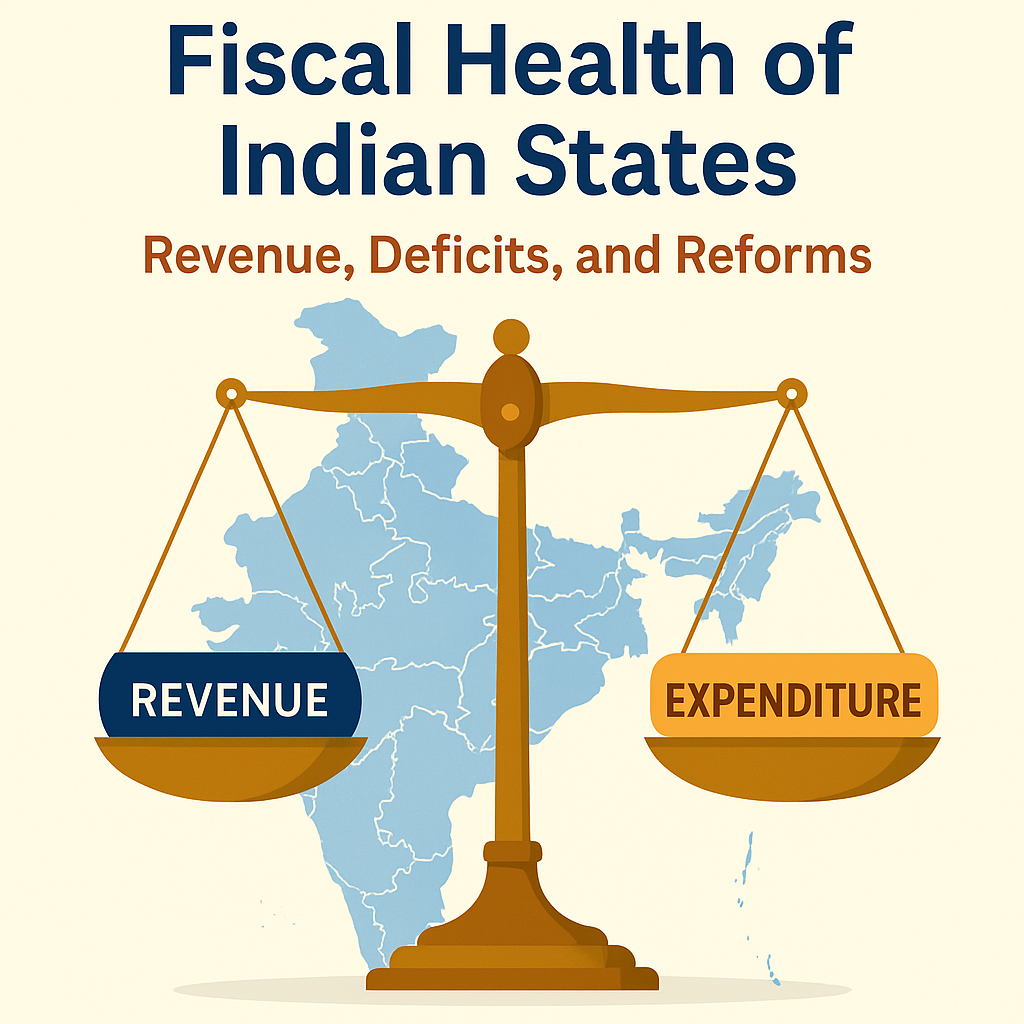
Introduction
The financial health of Indian states is not just about
budget numbers and revenue–expenditure balance. It reflects governance
capacity, sustainability of development programs, and the state’s ability to
deliver economic and social justice. In UPSC and State PSC exams, the topic
“Fiscal Health of States” is important under economy, federal relations, public
finance, and policy issues.
Major Points
1. Revenue Sources and Dependence
- Own
Revenue: How much states earn through their own taxes and non-tax
revenue (State GST, excise, economic activities, etc.).
- Dependence
on Centre: Grants, financial transfers, and inter-governmental support
from the Union government.
2. Expenditure Pattern
- Developmental
Expenditure: Spending on education, health, infrastructure.
- Non-developmental/Recurring
Expenditure: Salaries, pensions, administrative costs.
- Debt
Servicing: Rising burden of interest and loan repayment creating
fiscal stress.
3. Revenue Deficit and Fiscal Deficit
- Ability
of states to maintain a balanced budget.
- Financing
methods for deficits (borrowing, central assistance).
- Impact
of revenue deficit vs fiscal deficit on fiscal stability.
4. Debt Levels and Sustainability
- Total
debt and per-capita debt of state governments.
- Impact
of high debt burden on long-term economic growth.
- Issues
of debt repayment pressure and sustainability.
5. Monitoring and Reform Measures
- FRBM
Acts: Role of Fiscal Responsibility and Budget Management laws in
states.
- Revenue
Augmentation: Expanding tax base, reducing tax evasion and leakages.
- Expenditure
Management: Setting clear priorities, curbing wasteful expenditure,
promoting PPP models.
6. Case Study: Post-COVID Impact
- Revenue
fall due to lockdowns and slowdown.
- Expenditure
rise in health and relief measures.
- Recovery
measures: central support, emphasis on capital expenditure.
UPSC/PSC Exam Relevance
Possible Questions:
- “What
policy measures are required to improve the fiscal health of Indian
states?”
- “Discuss
the pros and cons of rising debt burdens on states.”
- “Differentiate
between revenue deficit and fiscal deficit. Suggest measures to control
them.”
Answer-Writing Tips:
- Start
with the definition of “Fiscal Health.”
- Cover revenue,
expenditure, debt, deficits in the main body.
- Use state-specific
examples (Kerala, Maharashtra, Uttar Pradesh, etc.) to show
comparative management.
- Conclude
with balanced reforms and the role of cooperative federalism.
Conclusion
Improving the fiscal health of Indian states is not only an
economic requirement but also essential for social welfare, good governance,
and long-term development. For UPSC/PSC, mastering this topic with data,
reports, and reform perspectives ensures better performance in exam answers.



Comments (0)
Leave a Comment