
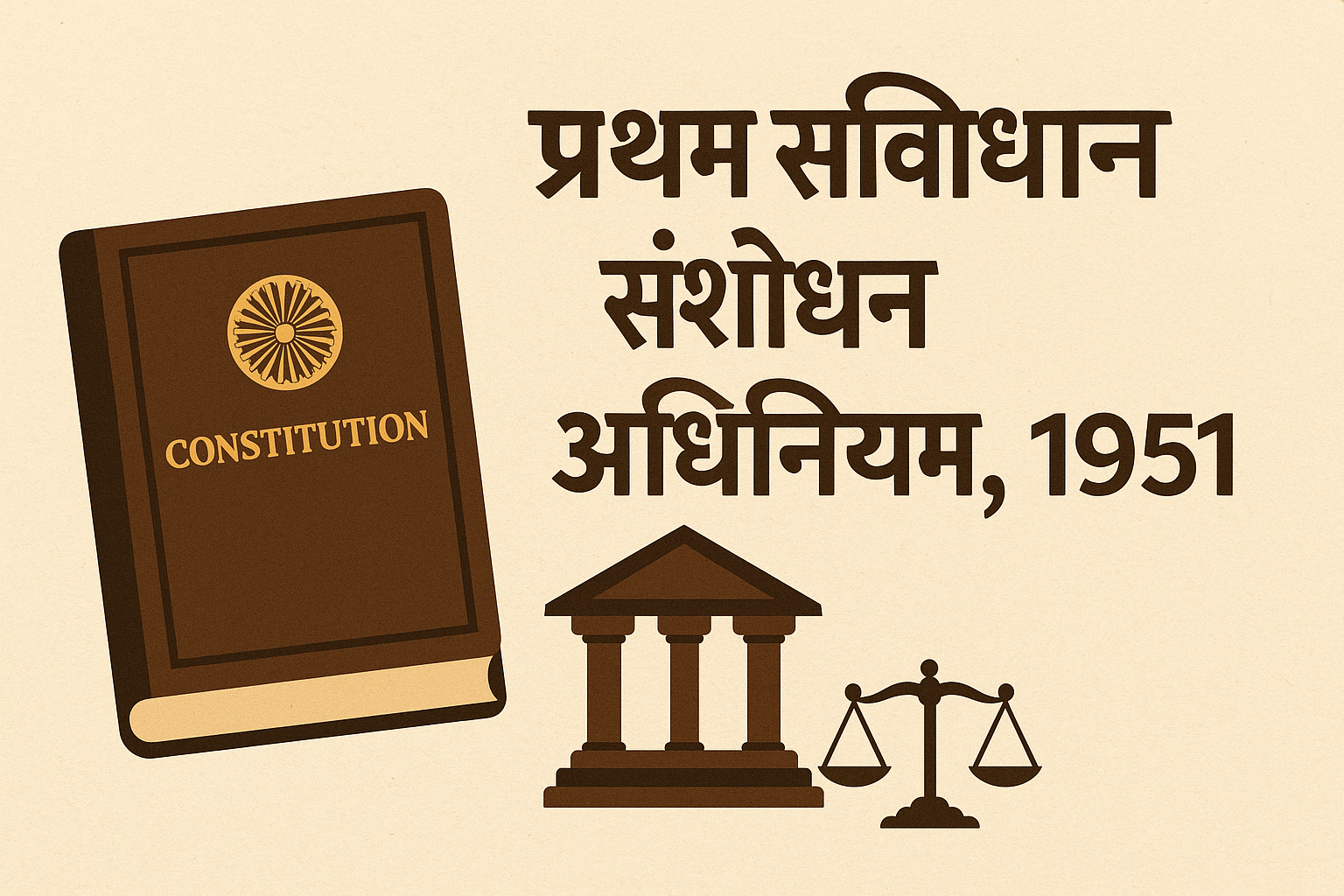
Background
-
The Constitution of India came into force on 26 January 1950.
-
Soon after its enforcement, some issues emerged:
-
Misuse of Fundamental Rights - especially the Right to Freedom of Speech and Expression (Article 19) was being used for anti-government speeches and activities.
-
Challenge to Zamindari Abolition Laws - many states passed land reform and zamindari abolition laws, but they were challenged in courts on the grounds of the Right to Property (Article 19(1)(f) and 31).
-
Obstacles in Social Justice - difficulties were faced in making special provisions for Scheduled Castes and Backward Classes.
-
To address these challenges, the Nehru Government introduced the First Constitutional Amendment in 1951.
Main Provisions
1. Reasonable Restrictions on Freedom of Speech
-
In the original Constitution, there were no specific restrictions under Article 19(1)(a).
-
The Supreme Court (in Romesh Thapar v. State of Madras, 1950 and Brij Bhushan v. State of Delhi, 1950) struck down government restrictions as unconstitutional.
-
The amendment added "reasonable restrictions" under Article 19(2).
-
Grounds for restrictions: Security of the State, Integrity of India, Public Order, Decency and Morality, Contempt of Court, Defamation, and Incitement to an Offence.
2. Land Reforms and Right to Property
-
Article 31B and the Ninth Schedule were inserted.
-
Purpose:
-
To protect land reform laws and zamindari abolition acts from judicial review.
-
Initially, 13 laws were included in the Ninth Schedule.
-
-
Article 31A was also inserted to safeguard agrarian reform laws from being declared unconstitutional.
3. Right to Equality and Special Provisions
-
Article 15(4) was added.
-
Empowered the State to make special provisions for the advancement of socially and educationally backward classes, Scheduled Castes, and Scheduled Tribes.
-
This became the constitutional basis of reservation policy in India.
-
4. Other Amendments
-
Article 19(1)(g) - freedom to practice any profession or trade could be reasonably restricted in the interest of the general public.
-
More clarity was provided regarding the powers of Parliament and State Legislatures.
Significance
-
It was the first and one of the most significant amendments to the Constitution.
-
Helped the government to implement socio-economic reforms.
-
Established a balance between Fundamental Rights and the interests of society.
-
Introduced the Ninth Schedule, which later became a tool to shield laws from judicial review (though the Supreme Court in I.R. Coelho Case, 2007 limited this protection).
Criticism
-
Termed as an "assault on freedom".
-
Critics argued it marked the beginning of the erosion of Fundamental Rights.
-
Press freedom was curtailed, and it was even called "draconian".
Key Points for Exams
-
Year - 1951
-
Objectives:
-
Implementation of Land Reforms
-
Constitutional basis for Reservation
-
Restrictions on Freedom of Speech
-
-
Ninth Schedule - Inserted
-
Articles Added - 15(4), 31A, 31B
-
Important Cases - Romesh Thapar (1950), Brij Bhushan (1950)
In Short
The First Constitutional Amendment Act, 1951 is regarded as one of the most revolutionary amendments to the Indian Constitution. It laid the foundation for land reforms, reservation policy, and reasonable restrictions on free speech in India.
Comments (0)
Leave a Comment