
Introduction
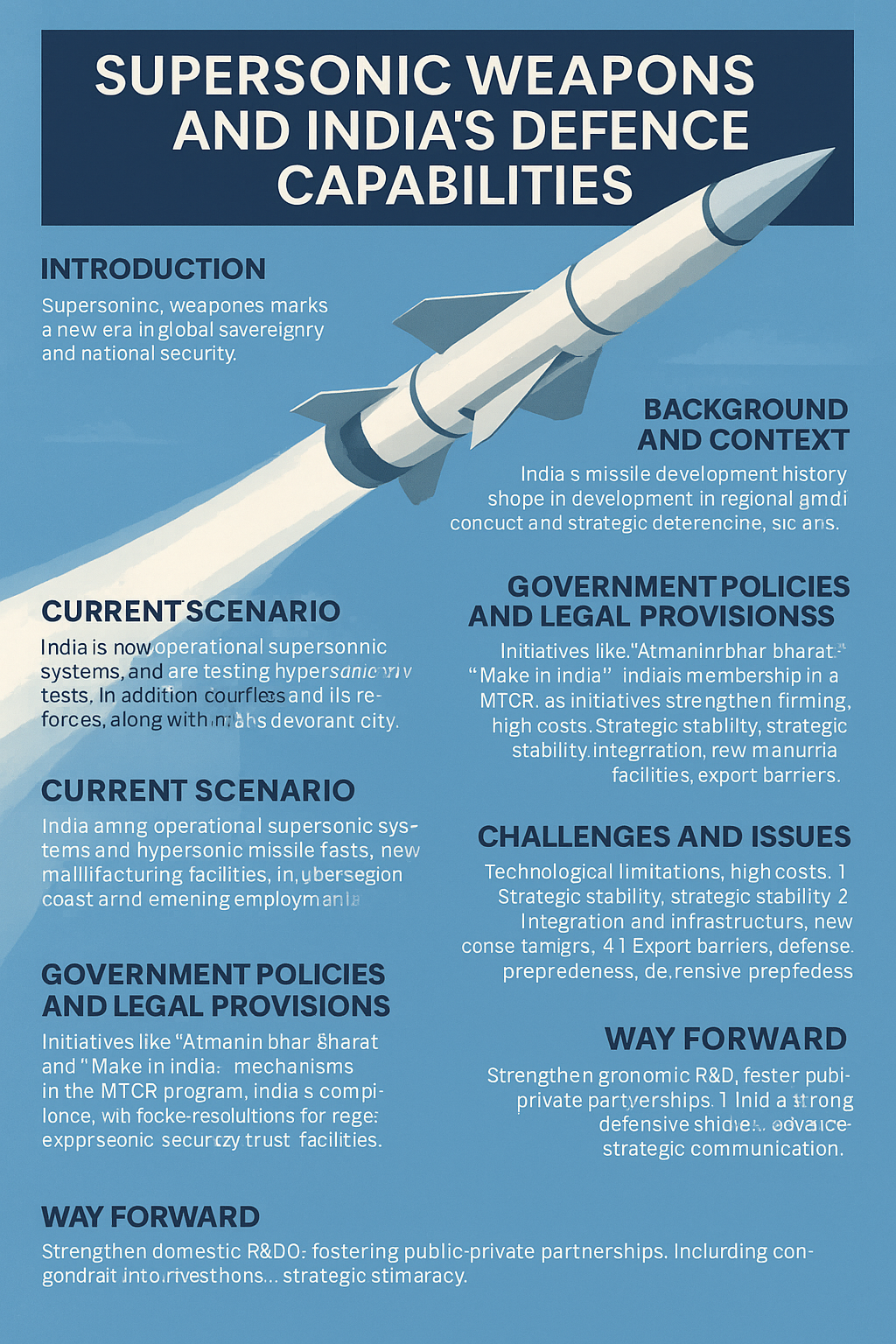
The development of supersonic and hypersonic weapons marks a new era in global military technology and national security. For India, this progress is not only about strengthening its defence but also about ensuring technological sovereignty and strategic deterrence. Supersonic weapons, which travel faster than the speed of sound, provide precision and quick-strike capabilities that are essential in modern warfare. In the Indian constitutional context, Article 51 emphasizes the duty of the State to protect sovereignty and promote international peace. Therefore, developing advanced defence technology such as supersonic weapons aligns with India’s developmental vision of self-reliance, peace, and preparedness in a volatile regional environment.
Background and Context
India’s journey in missile and advanced weapon development began in the 1980s with the Integrated Guided Missile Development Programme (IGMDP), which led to the creation of missiles like Prithvi, Agni, Akash, Nag, and Trishul. Over the years, India achieved significant milestones, such as the joint Indo-Russian development of a supersonic cruise missile capable of reaching speeds around Mach 2.8. This weapon system gave India a major strategic advantage in precision strike capability. Subsequently, the Defence Research and Development Organisation (DRDO) initiated programs to develop indigenous supersonic and hypersonic technologies using scramjet and ramjet propulsion systems.
Globally, countries like the United States, Russia, and China have already advanced into hypersonic glide vehicles and cruise missiles capable of speeds above Mach 5. In this context, India’s research and development in the supersonic domain is aimed at maintaining regional parity and securing its strategic frontiers.
Current Scenario
India is among the few nations that possess operational supersonic weapon systems and are testing hypersonic prototypes. The DRDO has successfully tested long-range variants of the supersonic cruise missile, extending its range beyond 800 km. In 2024, India conducted successful trials of a long-range hypersonic missile from the eastern coast, demonstrating propulsion stability and precise target accuracy. The Defence Research and Development Laboratory (DRDL) in Hyderabad achieved a significant milestone by conducting a scramjet combustor test lasting more than 1,000 seconds, showcasing India’s progress in high-speed propulsion technology.
Alongside this, India has been focusing on integrating these weapons across multiple platforms such as land, air, and sea. The Indian Navy, Army, and Air Force have all inducted supersonic missile variants for different strike purposes. Additionally, new manufacturing facilities are being established under the Defence Industrial Corridor in Uttar Pradesh and Tamil Nadu, ensuring indigenous production capacity, reducing import dependency, and creating employment opportunities.
Government Policies and Legal Provisions
The Indian government’s policy framework emphasizes indigenous defence production and advanced research through initiatives such as “Atmanirbhar Bharat” and “Make in India”. The Defence Acquisition Procedure encourages “Buy Indian” and “Make Indian” categories to promote domestic defence manufacturing. The Ministry of Defence has approved several modernization packages to enhance long-range precision strike capabilities, including supersonic cruise missiles, drones, and surveillance systems.
Legally, Article 51 of the Constitution promotes peace and security but also implies the responsibility to safeguard the nation’s integrity against external threats. India’s membership in international regimes such as the Missile Technology Control Regime (MTCR) in 2016 has opened opportunities for collaboration and range enhancement. Furthermore, DRDO’s strategic projects like the Hypersonic Technology Demonstrator Vehicle (HSTDV) are supported by government funding and policy reforms that focus on reducing bureaucratic delays in testing and procurement.
Challenges and Issues
-
Technological limitations: Hypersonic and supersonic technologies require advanced materials, precision engineering, and high-temperature propulsion systems. India still depends on foreign inputs in some components, making full indigenization difficult.
-
High cost and production scalability: Manufacturing these advanced systems is expensive, and maintaining large-scale production capability requires sustained funding.
-
Strategic stability: The deployment of high-speed weapons may alter regional power equations, increasing the risk of miscalculation or arms race dynamics in South Asia.
-
Integration and infrastructure: Effective use of supersonic systems requires integration across the three services, advanced radar, and communication systems. Gaps in network-centric warfare infrastructure limit optimal use.
-
Export and regulatory barriers: Stringent export controls and complex international regulations limit India’s ability to commercialize these technologies.
-
Defensive preparedness: While offensive strike capability is improving, India’s defence systems against enemy hypersonic missiles are still under development.
Way Forward
India should adopt a multi-pronged approach that combines technological innovation with strategic diplomacy.
-
Strengthen domestic R&D: More investment in DRDO and academic collaborations for propulsion systems, high-temperature materials, and artificial intelligence-driven targeting will accelerate progress.
-
Foster public-private partnerships: Collaboration with private industries and start-ups can help in component manufacturing and innovation.
-
Integrated command structure: India must evolve joint doctrines for tri-service use of supersonic and hypersonic systems, ensuring coordinated operations.
-
Build a strong defensive shield: Focus should also be on building missile defence systems capable of intercepting high-speed projectiles.
-
Strategic communication: India must promote regional transparency to avoid escalation and maintain strategic stability while asserting deterrence.
-
Human resource development: Specialized training and research programs for scientists and engineers in aerospace technology will ensure long-term sustainability.
Significance for Exams
For Prelims:
-
India’s Integrated Guided Missile Development Programme (IGMDP) started in 1983.
-
The DRDO developed a long-range supersonic cruise missile with a speed of around Mach 2.8.
-
India became a member of the Missile Technology Control Regime (MTCR) in 2016.
-
The Hypersonic Technology Demonstrator Vehicle (HSTDV) program aims to test scramjet engine technology.
-
Defence Industrial Corridors have been established in Uttar Pradesh and Tamil Nadu.
-
Article 51 of the Constitution mentions the duty of the State to promote peace and safeguard sovereignty.
-
DRDL in Hyderabad conducted a scramjet combustor test for over 1,000 seconds in 2025.
-
The extended range version of India’s supersonic cruise missile is under testing for 800 km range.
For Mains:
-
India’s missile advancement enhances strategic deterrence and ensures technological independence.
-
Supersonic weapon development supports India’s aspiration for self-reliance under Atmanirbhar Bharat.
-
The balance between offensive and defensive capabilities is essential to maintain regional peace.
-
Indigenous production of such systems contributes to employment, industrial growth, and R&D capability.
-
Global strategic stability depends on transparency and responsible use of high-speed weapons.
-
Hypersonic technology will influence India’s maritime and aerospace defence strategy in the coming decade.
For Interview:
-
Supersonic weapons are a symbol of India’s technological maturity and strategic preparedness.
-
Development of these weapons should focus on deterrence, not aggression.
-
India’s defence growth must align with peace and international stability principles.
-
The goal should be self-reliance, not militarization.
In Short
Supersonic and hypersonic weapons reflect India’s growing capability in advanced defence technology. The key challenge is to balance innovation and strategic responsibility while ensuring self-reliance and peace. Strengthening R&D, industrial capacity, and global cooperation will help India transform its defence sector into a modern, technology-driven force.



Comments (0)
Leave a Comment