
Introduction
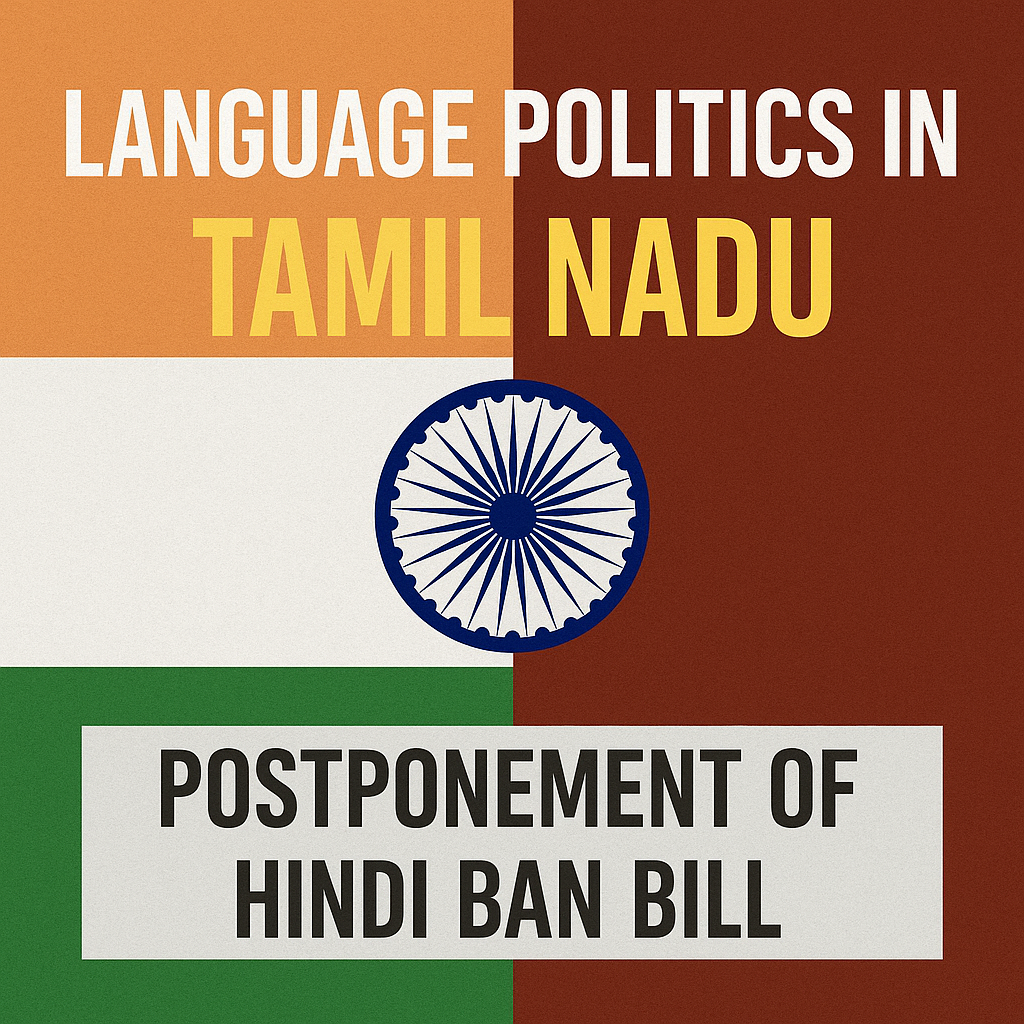
The question of language has always held a deep socio-political significance in India, a country of immense linguistic diversity. The recent discussions in Tamil Nadu regarding the proposal and subsequent deferment of a bill perceived as restricting the use of Hindi highlight the continuing sensitivities surrounding linguistic identity and federal harmony. While the proposal was aimed at protecting regional language autonomy, its deferment reflects the government’s cautious approach to avoid friction with constitutional principles and national unity. This issue offers important insights into India’s linguistic federalism, cultural pluralism, and the evolving nature of language policy.
Background and Context
The roots of India’s language politics go back to the pre-independence period when debates on the national language became intense. The Constituent Assembly ultimately recognized Hindi in Devanagari script as the official language of the Union, while English was allowed to continue for an initial period of 15 years, later extended indefinitely through the Official Languages Act, 1963.
In southern states, particularly Tamil Nadu, language has been closely linked to regional pride and political assertion. The anti-Hindi agitations of 1937–40 and 1965 played a decisive role in shaping the Dravidian political identity. The demand for linguistic equality and resistance to perceived Hindi imposition led to the evolution of a strong regional linguistic consciousness.
Over the decades, Tamil Nadu has consistently emphasized the two-language formula, promoting Tamil and English, in contrast to the three-language model followed elsewhere. The proposed bill against Hindi use in certain government communications was seen as an extension of this long-standing policy, rooted in the idea of preserving Tamil linguistic autonomy.
Current Scenario
In 2024, reports indicated that Tamil Nadu’s legislative discussions included a draft proposal to regulate the compulsory use of Hindi in state institutions and public signage. The draft bill, although not introduced formally, triggered national debates on linguistic freedom and cooperative federalism. Subsequently, the state government decided to defer the bill, stating the need for broader consultations and constitutional vetting.
The move came amid wider national discussions on promoting Indian languages under the National Education Policy (NEP) 2020 and initiatives for administrative bilingualism. The deferment thus signals a balance between linguistic assertion and pragmatic governance. It also underlines how language remains both a cultural right and a governance challenge in India’s diverse polity.
Government Policies and Legal Provisions
-
Article 343 designates Hindi in Devanagari script as the official language of the Union, while English continues as an associate official language.
-
Article 345 allows states to adopt any language used in the state as their official language.
-
Article 351 directs the Union to promote the spread of Hindi without harming other languages.
-
The Official Languages Act, 1963, provides for continued use of English in official communication.
-
The Eighth Schedule of the Constitution currently recognizes 22 official languages, including Tamil and Hindi.
-
The National Education Policy (2020) emphasizes multilingualism and mother tongue-based education.
Challenges and Issues
-
Regional Sensitivities – Language is closely tied to identity; any perceived imposition can trigger strong emotional and political reactions.
-
Federal Balance – Ensuring linguistic harmony while maintaining the unity of administration poses a constant challenge.
-
Policy Contradictions – National promotion of Hindi coexists with regional protection of other languages, often leading to conflicting priorities.
-
Educational Implementation – The three-language formula faces practical barriers in non-Hindi states where Hindi learning is unpopular.
-
Employment Concerns – Central recruitment exams in Hindi or English sometimes disadvantage non-Hindi speakers.
-
Cultural Integration vs. Autonomy – Balancing national integration with respect for local linguistic pride requires careful policy design.
Way Forward
-
Strengthen the constitutional principle of linguistic equality by reaffirming respect for all regional languages.
-
Promote voluntary and incentive-based language learning rather than compulsion.
-
Encourage translation, interpretation, and digital language tools to bridge communication gaps between states.
-
Enhance inter-state academic exchange programs to foster linguistic understanding among youth.
-
Implement the NEP 2020 in a flexible, region-sensitive manner that aligns with local linguistic priorities.
-
Establish an inter-state linguistic coordination council under the Inter-State Council to resolve future language disputes peacefully.
Significance for Exams
For Prelims:
-
Article 343 – Official language of the Union is Hindi in Devanagari script.
-
Article 345 – States can adopt their own official languages.
-
Official Languages Act – 1963.
-
Anti-Hindi agitation in Tamil Nadu – 1937–40 and 1965.
-
Eighth Schedule – 22 languages.
-
National Education Policy – 2020 promotes multilingualism.
-
Two-language policy of Tamil Nadu emphasizes Tamil and English.
-
Article 351 – Directive for promotion of Hindi.
For Mains:
-
Language policy reflects the spirit of cooperative federalism.
-
Tamil Nadu’s experience illustrates how linguistic diversity coexists within national unity.
-
Balancing regional aspirations with national integration is essential for social harmony.
-
NEP 2020 represents a shift from linguistic uniformity to inclusive multilingualism.
-
Strengthening linguistic respect fosters inclusive governance.
-
The deferment of the Tamil Nadu bill shows the maturity of democratic institutions in addressing sensitive issues through dialogue.
For Interview:
-
Language diversity is India’s cultural strength, not a barrier.
-
Policies should encourage harmony, not competition among languages.
-
Cooperative federalism can resolve linguistic disputes amicably.
-
Respect for regional languages strengthens national integration.
In Short
The deferment of the Tamil Nadu bill on Hindi restriction demonstrates India’s constitutional maturity in managing linguistic diversity. Preserving regional identities while promoting inter-lingual understanding remains vital to the cooperative and pluralistic spirit of Indian democracy.






Comments (0)
Leave a Comment