
Introduction
Energy security has always been a cornerstone of India’s developmental and constitutional vision. The Directive Principles of State Policy emphasize the optimal use of natural resources for the welfare of the people, which includes ensuring a reliable and sustainable energy supply. In this context, Small Modular Reactors (SMRs) are emerging as a new frontier in nuclear energy technology. They represent a solution that combines clean energy generation with enhanced safety and flexibility. As India works toward achieving its net-zero target by 2070, SMRs could play a pivotal role in reducing carbon emissions while ensuring consistent power for growth and welfare.
Background and Context
India’s nuclear journey began in the early decades after independence when the Atomic Energy Commission was established in 1948 under the visionary guidance of Dr. Homi J. Bhabha. The country’s nuclear power program evolved through three stages—natural uranium reactors, fast breeder reactors, and thorium-based reactors. Traditional reactors such as the Pressurized Heavy Water Reactors (PHWRs) and Boiling Water Reactors (BWRs) have been the backbone of India’s nuclear power generation. However, these large-scale plants require massive capital, long construction periods, and complex safety infrastructure.
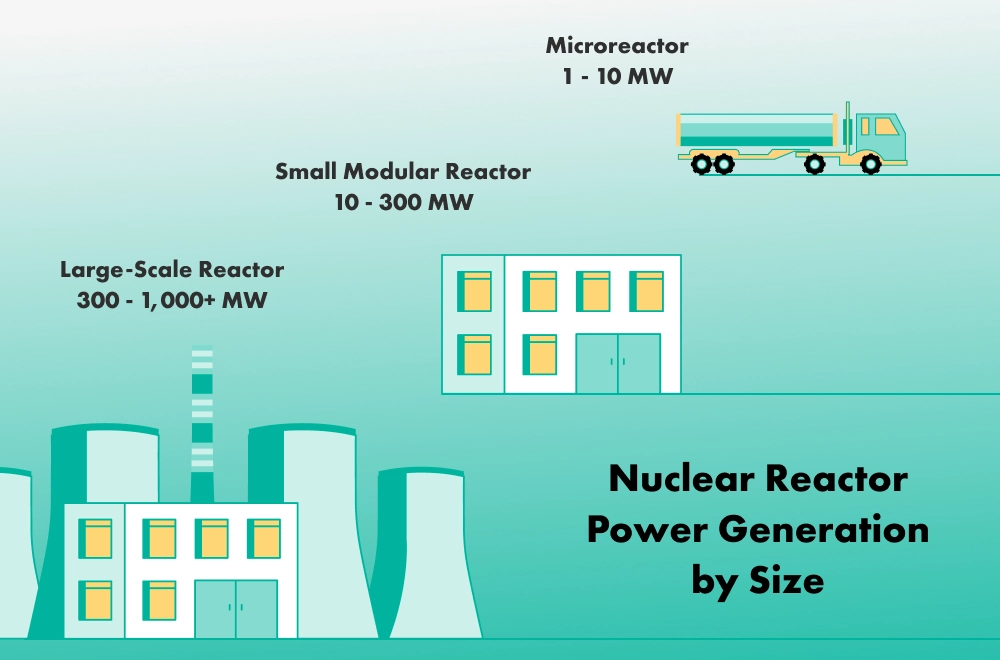
Small Modular Reactors are designed to address these limitations. They typically produce up to 300 megawatts per unit and can be built in factories, transported to the site, and installed in modules as per demand. Their modularity allows for easier scalability and cost control. Globally, countries like the United States, Russia, Canada, and the United Kingdom have initiated SMR projects, demonstrating their potential to complement renewable sources like solar and wind.
Current Scenario
As of 2025, India operates 23 nuclear reactors with a total installed capacity of approximately 7480 MW. The Nuclear Power Corporation of India Limited (NPCIL) has set a target of achieving about 22,000 MW of nuclear capacity by 2031. The Department of Atomic Energy (DAE) and the Bhabha Atomic Research Centre (BARC) are exploring advanced reactor designs, including Small Modular Reactors. The Government of India has also announced a “Nuclear Energy Mission” under the Union Budget 2025-26 to promote research, indigenous development, and demonstration projects in the SMR category.
Globally, there are more than 80 SMR designs under different stages of development. The International Atomic Energy Agency (IAEA) has recognized SMRs as a key component of the future energy mix, citing their flexibility, smaller footprint, and enhanced safety. For India, SMRs are particularly relevant for remote regions, small industrial clusters, and hydrogen production hubs.
Government Policies and Legal Provisions
The Indian nuclear sector is governed by the Atomic Energy Act, 1962, and regulated by the Atomic Energy Regulatory Board (AERB). The Civil Liability for Nuclear Damage Act, 2010, outlines the responsibility framework for nuclear operators and suppliers. India is also a signatory to international conventions on nuclear safety.
SMR development aligns with national missions such as the Make in India initiative, the National Hydrogen Mission, and the Energy Transition Roadmap. The government aims to involve both public and private sectors in non-nuclear components like design and manufacturing under strict regulation. Encouraging private participation could attract innovation, reduce costs, and accelerate deployment.
Challenges and Issues
-
High capital costs and long gestation periods can affect financial viability.
-
Public apprehension regarding nuclear safety continues despite technological advancements.
-
Nuclear waste disposal and long-term storage remain complex environmental challenges.
-
The current liability framework may discourage private investors due to financial risks.
-
Limited availability of trained manpower in advanced nuclear technology.
-
Need for global standardization of SMR designs for international collaboration and export potential.
Way Forward
India must adopt a balanced approach combining innovation, safety, and public trust. The following steps are essential:
-
Establish pilot SMR projects under government funding to demonstrate technical feasibility.
-
Develop clear policy guidelines on safety, waste management, and liability sharing.
-
Promote cooperation between DAE, NPCIL, NTPC, and academic institutions for R&D.
-
Enhance public communication on the benefits and safety of nuclear energy to reduce fear.
-
Integrate SMRs with renewable energy systems and hydrogen plants to provide continuous clean power.
-
Create a transparent regulatory framework with an independent Nuclear Safety Authority to build global confidence.
Significance for Exams
For Prelims
-
Atomic Energy Act enacted in 1962.
-
Civil Liability for Nuclear Damage Act passed in 2010.
-
India’s current nuclear capacity: around 7480 MW (2025).
-
Target for 2031: 22,000 MW.
-
NPCIL – operator of India’s commercial reactors.
-
BARC – leading research organization for SMR technology.
-
Net Zero emission target – by 2070.
-
IAEA – monitors global nuclear safety and technology cooperation.
For Mains
-
Discuss how SMRs can strengthen India’s clean energy transition.
-
Evaluate the economic and environmental viability of SMRs compared to large reactors.
-
Examine India’s nuclear liability framework and its impact on private participation.
-
Analyze the potential of SMRs in achieving energy equity across regions.
-
Highlight the role of innovation and public awareness in promoting nuclear acceptance.
For Interview
-
SMRs represent the convergence of safety, sustainability, and scalability in energy generation.
-
India’s focus on modular reactors reflects a pragmatic approach to energy transition.
-
Future energy policy must integrate nuclear energy with renewables for balanced growth.
In Short
Small Modular Reactors provide a realistic pathway toward achieving India’s goals of clean, safe, and sustainable energy. By balancing innovation with responsibility, India can lead the next generation of nuclear technology in the developing world.







Comments (0)
Leave a Comment