
Background
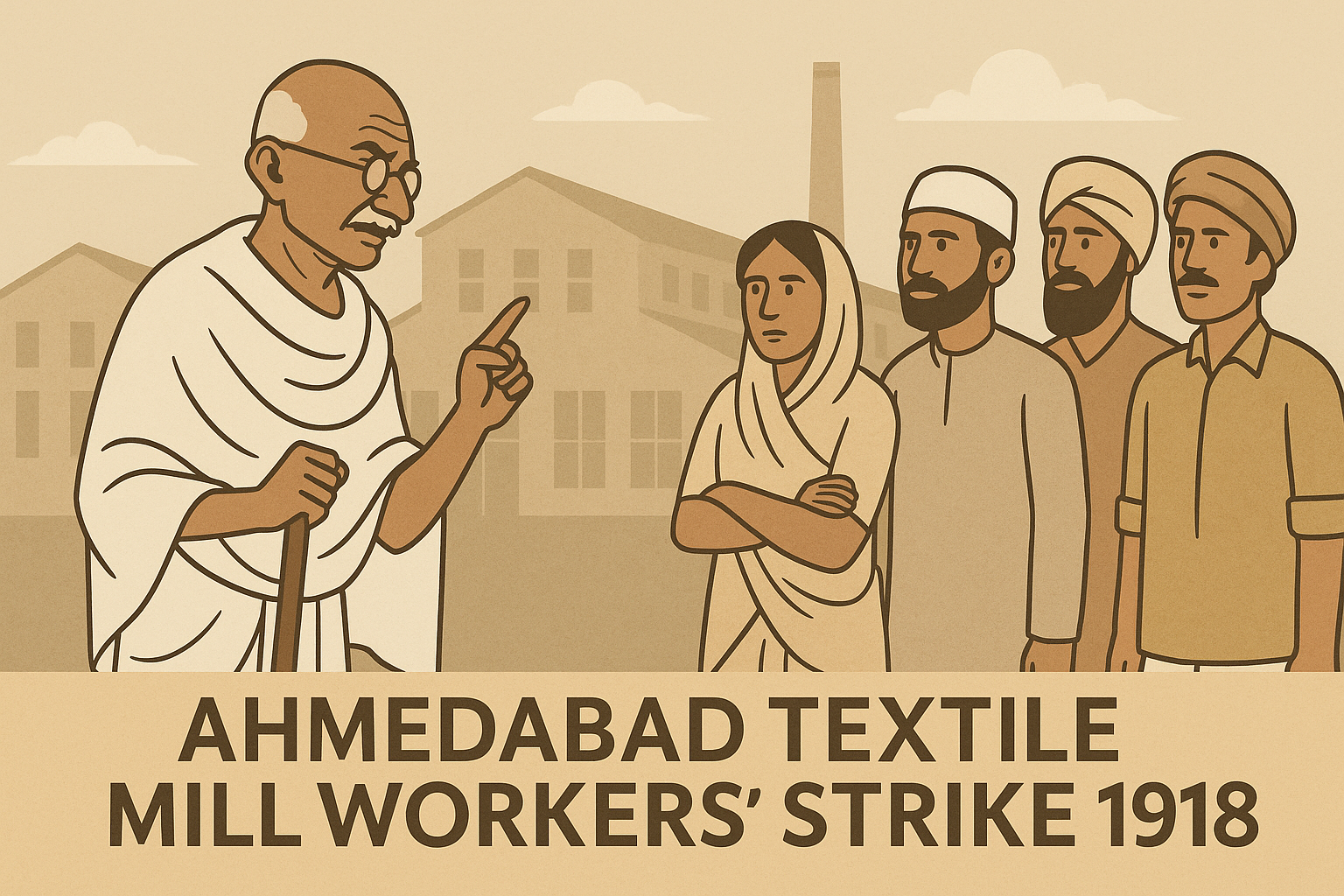
The Ahmedabad Mill
Workers’ Strike of 1918 was one of the earliest and most significant labor
movements in India under the leadership of Mahatma Gandhi. It took place in
Ahmedabad, Gujarat, and marked the first major instance of Gandhi applying the
principle of Satyagraha to an industrial dispute. The strike was an important
step in uniting workers and demonstrating the power of non-violent protest in
social and economic struggles.
The strike arose due to
disputes between the mill owners and workers over wages during a period of
economic hardship following World War I. Inflation had increased the cost of
living, and the workers demanded a wage hike of 50 percent. The mill owners, however,
agreed to only a 20 percent increase. The conflict intensified, leading to a
strike that would become a model of peaceful labor protest in India.
Important Facts for
Prelims Exams
- Year: 1918
- Place: Ahmedabad, Gujarat
- Leaders: Mahatma Gandhi, Anasuya Sarabhai, Shankarlal Banker
- Nature of Movement: Non-violent labor strike (Industrial
Satyagraha)
- Duration: About 21 days
- Demand: 50 percent wage increase
- Outcome: Settlement through arbitration; 35 percent wage increase granted
- Significance: First successful application of Satyagraha
in industrial relations
Main Provisions and
Key Facts
- Background of the Dispute
- During World War I, the prices of essential
commodities rose sharply, making it difficult for mill workers to sustain
their families.
- The workers of Ahmedabad textile mills
demanded a 50 percent increase in wages.
- The mill owners refused and declared a
lockout.
- Role of Mahatma Gandhi
- Gandhi intervened as a mediator between mill
owners and workers.
- When negotiations failed, Gandhi supported
the workers' decision to strike but insisted on maintaining peace and
discipline.
- He advised workers to rely on truth and
non-violence, not aggression.
- Fasting by Gandhi
- When workers started losing patience, Gandhi
undertook a fast to reaffirm their commitment to non-violence and unity.
- His moral authority inspired workers to
continue peacefully.
- The fast lasted three days and received
national attention.
- Support from Anasuya Sarabhai
- Anasuya Sarabhai, sister of industrialist
Ambalal Sarabhai, played a crucial role in organizing the workers.
- She later became one of the founding figures
of the textile labor union movement in India.
- Settlement
- The dispute was finally settled through
arbitration.
- The workers received a 35 percent wage
increase.
- The strike ended peacefully after about
three weeks.
- Formation of Labor Organization
- Following the strike, Gandhi established the
Ahmedabad Textile Labour Association (Majdur Mahajan Sangh) in 1918.
- It became one of India’s earliest and most
successful trade unions, based on mutual trust and non-violence.
Significance
- The strike was the first example of applying
Gandhian Satyagraha principles in an industrial dispute.
- It demonstrated that social and economic
justice could be achieved through non-violent methods.
- The success of the strike strengthened
Gandhi’s reputation as a national leader.
- It promoted unity between workers and set an
example for future labor movements.
- The Ahmedabad Textile Labour Association
became a model for ethical labor relations.
- It encouraged the working class to become a
part of India’s larger freedom struggle.
Criticism or
Limitations
- The strike did not bring any structural
changes to the industrial system.
- Some critics argued that the moral approach
was not sustainable without economic reforms.
- Dependence on Gandhi’s personal leadership
limited the independent strength of labor unions.
- The success was localized and did not
immediately spread to other industrial centers.
Despite these
limitations, the Ahmedabad Mill Strike remained an inspiring example of moral
power and organized resistance.
Key Points for Exams
- Year: 1918
- Place: Ahmedabad, Gujarat
- Main Leaders: Mahatma Gandhi, Anasuya Sarabhai, Shankarlal
Banker
- Demand: 50% wage increase; settled at 35%
- Nature: Non-violent labor strike (Industrial Satyagraha)
- Organization formed: Ahmedabad Textile Labour Association (1918)
- Duration: 21 days
- Significance: First use of Gandhian methods in a labor
dispute
- Result: Strengthened faith in Satyagraha as an instrument of justice
- Governor during the strike: Sir George Lloyd (Bombay Presidency)
In Short
The Ahmedabad Mill
Workers’ Strike (1918) was Gandhi’s first experiment in applying Satyagraha to
labor issues. It united workers through truth and non-violence and secured a
fair wage increase, establishing a foundation for ethical labor movements in India.
Comments (0)
Leave a Comment