
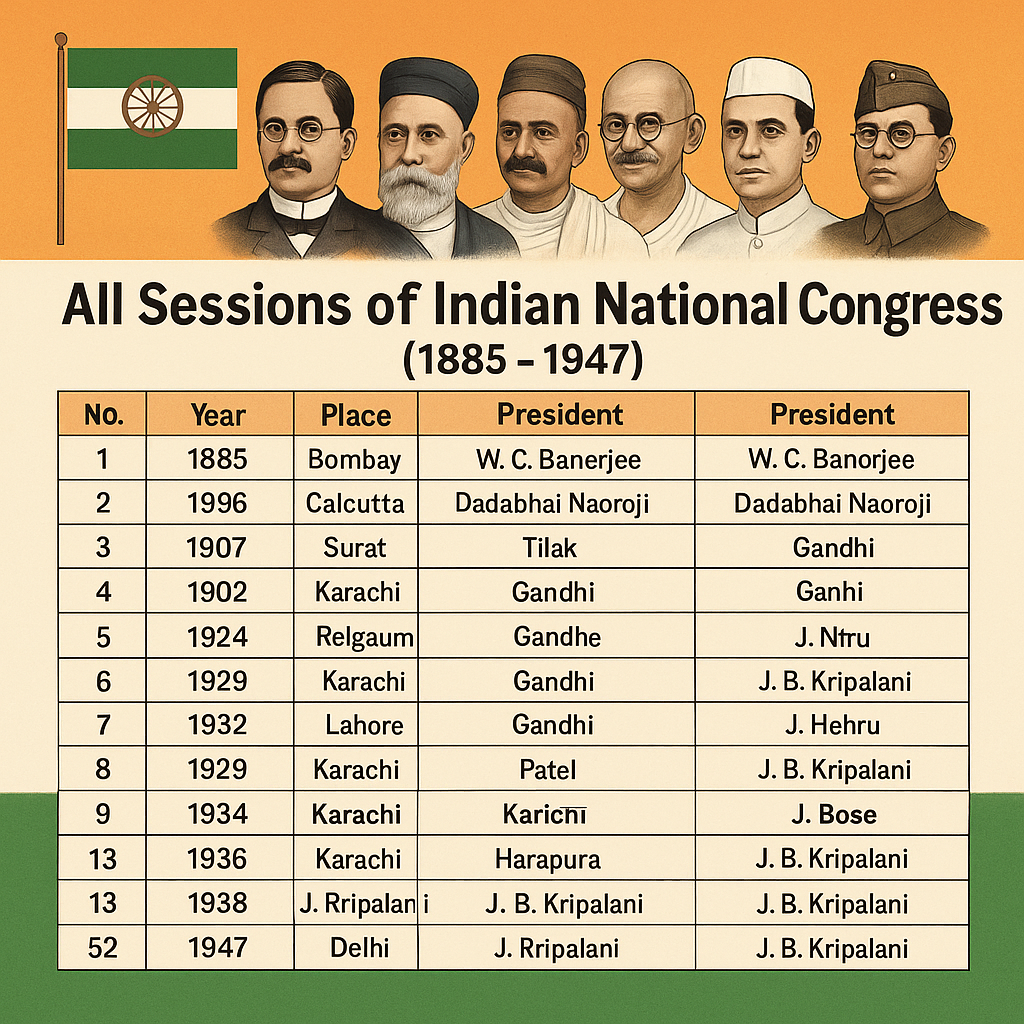
Background
The Indian National Congress (INC) was the first all-India
political organization that provided a common platform for Indians to express
their grievances and aspirations under British rule. Founded in 1885 by A.O.
Hume, it evolved from moderate reformist demands to a full-fledged national
movement for independence.
Each annual session of the Congress became a landmark event where crucial
decisions, strategies, and resolutions shaped the course of India’s freedom
struggle. Between 1885 and 1947, a total of 52 sessions were held,
reflecting the evolution of Indian politics.
Main Provisions and Key Facts (All 52 Sessions)
|
No. |
Year |
Place |
President |
Major
Decisions / Events |
|
1 |
1885 |
Bombay |
W. C.
Banerjee |
Foundation of
Congress; 72 delegates attended |
|
2 |
1886 |
Calcutta |
Dadabhai
Naoroji |
Defined aims
of Congress |
|
3 |
1887 |
Madras |
Badruddin
Tyabji |
Emphasis on
Hindu-Muslim unity |
|
4 |
1888 |
Allahabad |
George Yule |
First
Englishman as President |
|
5 |
1889 |
Bombay |
Sir William
Wedderburn |
Discussed
administrative reforms |
|
6 |
1890 |
Calcutta |
Pherozeshah
Mehta |
Demanded
Indian participation in governance |
|
7 |
1891 |
Nagpur |
P. Anand
Charlu |
Reviewed 1892
Council Act |
|
8 |
1892 |
Allahabad |
W. C.
Banerjee |
Supported
reforms under 1892 Act |
|
9 |
1893 |
Lahore |
Dadabhai
Naoroji |
Discussed
economic exploitation |
|
10 |
1894 |
Madras |
Alfred Webb |
Irishman
presided; solidarity with India |
|
11 |
1895 |
Poona |
Surendranath
Banerjee |
Focus on
administrative reforms |
|
12 |
1896 |
Calcutta |
Rahimtulla
Sayani |
Emphasized
Swadeshi goods |
|
13 |
1897 |
Amraoti |
C. Sankaran
Nair |
Nationalist
awakening |
|
14 |
1898 |
Madras |
Ananda Charlu |
Need for
political awakening |
|
15 |
1899 |
Lucknow |
R. C. Dutt |
Criticized
British economic policies |
|
16 |
1900 |
Lahore |
N. G.
Chandavarkar |
Indian
representation in governance |
|
17 |
1901 |
Calcutta |
Dinshaw Wacha |
Freedom of
Press discussed |
|
18 |
1902 |
Ahmedabad |
Surendranath
Banerjee |
National
consciousness spread |
|
19 |
1903 |
Madras |
Lal Mohan
Ghosh |
Focus on
reforms |
|
20 |
1904 |
Bombay |
Henry Cotton |
Strengthening
Congress organization |
|
21 |
1905 |
Benares |
Gopal Krishna
Gokhale |
Protest
against Bengal Partition |
|
22 |
1906 |
Calcutta |
Dadabhai
Naoroji |
First demand
for “Swaraj” |
|
23 |
1907 |
Surat |
Rash Behari
Ghosh |
Split between
Moderates & Extremists |
|
24 |
1908 |
Madras |
Dr. Rashmi
Kumar Dutt |
Called for
unity |
|
25 |
1910 |
Allahabad |
Sir William
Wedderburn |
National
unity emphasized |
|
26 |
1911 |
Calcutta |
Bishan
Narayan Dhar |
Mention of
capital shift to Delhi |
|
27 |
1914 |
Madras |
B. N. Dhar |
Criticized
British policies |
|
28 |
1916 |
Lucknow |
Ambica Charan
Majumdar |
Lucknow Pact
with Muslim League |
|
29 |
1917 |
Calcutta |
Annie Besant |
Supported
Home Rule Movement |
|
30 |
1918 |
Bombay |
Madan Mohan Malaviya |
Discussed
reforms of 1919 Act |
|
31 |
1919 |
Amritsar |
Motilal Nehru |
Condemned
Jallianwala Bagh massacre |
|
32 |
1920 |
Nagpur |
C. R. Das |
Adopted
Non-Cooperation Movement |
|
33 |
1921 |
Ahmedabad |
Hakim Ajmal
Khan |
Discussed
progress of Non-Cooperation |
|
34 |
1922 |
Gaya |
C. R. Das |
Division
after withdrawal of movement |
|
35 |
1923 |
Delhi |
Maulana
Mohammad Ali |
Supported
Swaraj Party |
|
36 |
1924 |
Belgaum |
Mahatma
Gandhi |
Gandhi’s only
Congress presidency |
|
37 |
1925 |
Kanpur |
Sardar
Vallabhbhai Patel |
Organizational
strengthening |
|
38 |
1926 |
Madras |
S. Srinivas
Iyengar |
Peasant
issues discussed |
|
39 |
1927 |
Madras |
M. A. Ansari |
Decision to
boycott Simon Commission |
|
40 |
1928 |
Calcutta |
Motilal Nehru |
Nehru Report
(Constitution Draft) |
|
41 |
1929 |
Lahore |
Jawaharlal
Nehru |
Purna Swaraj
(Complete Independence) resolution |
|
42 |
1931 |
Karachi |
Sardar
Vallabhbhai Patel |
Approved
Gandhi-Irwin Pact; Fundamental Rights adopted |
|
43 |
1932 |
Delhi |
Madan Mohan
Malaviya |
Discussion on
Round Table Conference |
|
44 |
1934 |
Bombay |
Rajendra
Prasad |
Decision on
provincial elections |
|
45 |
1936 |
Lucknow |
Jawaharlal
Nehru |
Socialism
declared as Congress goal |
|
46 |
1937 |
Faizpur |
Jawaharlal
Nehru |
Focused on
peasants and workers |
|
47 |
1938 |
Haripura |
Subhas
Chandra Bose |
National
Planning Committee formed |
|
48 |
1939 |
Tripuri |
Rajendra
Prasad (acting) |
Bose resigned
from presidency |
|
49 |
1940 |
Ramgarh |
Abul Kalam
Azad |
Opposed
cooperation in WWII |
|
50 |
1942 |
Bombay |
Acharya J. B.
Kripalani |
Quit India
Movement launched |
|
51 |
1946 |
Meerut |
J. B.
Kripalani |
Decision to
join Interim Govt |
|
52 |
1947 |
Delhi |
J. B.
Kripalani |
Policies for
free India declared |
Significance
- The 52
sessions chronicle India’s transformation from petitions to revolution.
- The
Congress became the political voice of the entire nation.
- Resolutions
like Swaraj (1906), Purna Swaraj (1929), and Quit India
(1942) marked turning points.
- Leadership
evolved — Naoroji to Gandhi to Nehru — symbolizing political maturity.
- These
sessions created the democratic tradition that shaped India’s future
government.
Criticism / Limitations
- Early
sessions were dominated by elites and lacked rural representation.
- Internal
divisions (Surat 1907, Tripuri 1939) weakened unity.
- Some
resolutions lacked immediate results due to British repression.
Key Points for Exams
- Total
Sessions – 52
- First
Session – 1885, Bombay, President: W. C. Banerjee
- Last
(Pre-Independence) Session – 1947, Delhi, President: J. B. Kripalani
- “Swaraj”
Demand – 1906 (Calcutta)
- Lucknow
Pact – 1916
- Non-Cooperation
– 1920 (Nagpur)
- Purna
Swaraj – 1929 (Lahore)
- Fundamental
Rights – 1931 (Karachi)
- Quit
India – 1942 (Bombay)
In Short
The 52 sessions of the Indian National Congress (1885–1947)
reflected India’s political awakening and led step-by-step from reformist
petitions to complete independence in 1947.
Comments (0)
Leave a Comment