
Background
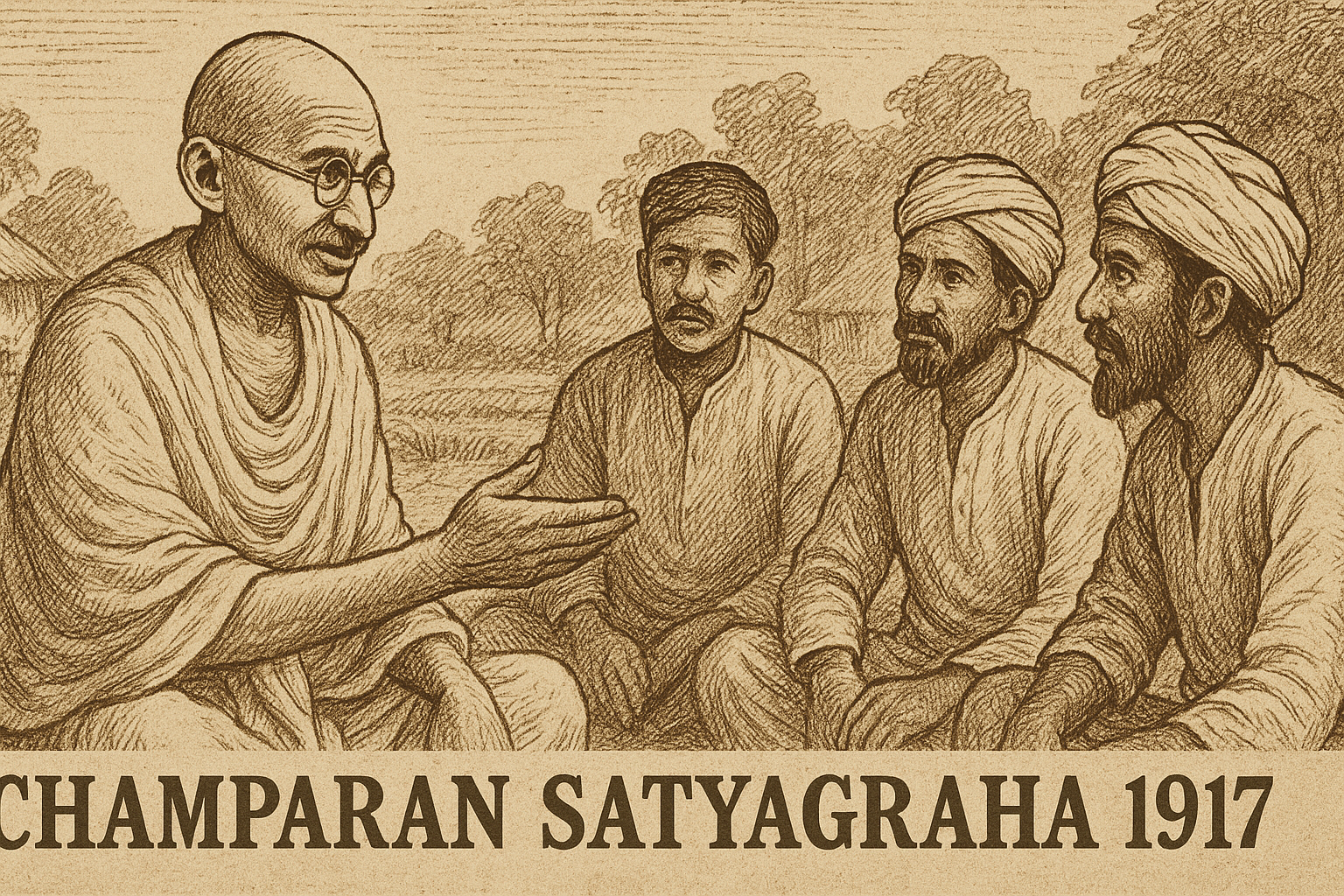
The Champaran Satyagraha
of 1917 was the first major civil disobedience movement led by Mahatma Gandhi
in India. It marked the beginning of Gandhi’s active participation in the
Indian freedom struggle and introduced the concept of Satyagraha (truth-force
or nonviolent resistance) as a tool against injustice. The movement took place
in Champaran district of Bihar, where local peasants were being exploited by
British indigo planters under a system known as the Tinkathia system.
Under this system,
peasants were forced to cultivate indigo on three-twentieths (about 15%) of
their land and sell it to the British at fixed low prices. Even after the
discovery of synthetic indigo, when the demand for natural indigo declined, the
British planters continued to exploit farmers for their profit. Gandhi’s entry
into this issue gave the peasants hope and a voice to resist oppression through
peaceful means.
The Champaran Satyagraha
is considered the first successful experiment of Gandhian non-violent
resistance in India and set the tone for later movements like the Kheda
Satyagraha, Non-Cooperation Movement, and Civil Disobedience Movement.
Main Provisions and
Key Facts
- Background of Exploitation
- The British indigo planters in Champaran
exploited farmers through the Tinkathia system.
- Peasants had to grow indigo on part of their
land, reducing food production and increasing poverty.
- Even after the global decline in indigo
demand, planters forced farmers to continue production.
- Arrival of Mahatma Gandhi
- In 1917, local leaders like Raj Kumar Shukla
invited Gandhi to Champaran to investigate the plight of peasants.
- Gandhi arrived despite opposition from
British authorities.
- His strategy was to gather facts, involve
the people, and use non-violence and truth to resist injustice.
- Role of Local Leaders
- Key associates: Rajendra Prasad, J. B.
Kripalani, Mazharul Haque, Mahadev Desai, and Narhari Parikh.
- Gandhi mobilized local lawyers and educated
youth to record testimonies of farmers.
- He emphasized self-reliance, sanitation, and
education alongside political protest.
- Government Response
- The British government initially ordered
Gandhi to leave Champaran.
- Gandhi refused and said he would face
punishment rather than abandon the cause.
- This was Gandhi’s first act of civil
disobedience in India.
- Formation of Enquiry Committee
- Due to increasing public pressure, the
British government appointed a Champaran Inquiry Committee with Gandhi as
a member.
- The committee investigated the farmers’
grievances and confirmed exploitation by indigo planters.
- Outcome
- The British accepted most of the committee’s
recommendations.
- The Tinkathia system was abolished.
- Farmers gained relief from forced indigo
cultivation and became more politically aware.
- Social Reforms
- Gandhi focused not only on political issues
but also on moral and social upliftment.
- He established schools, improved sanitation,
and encouraged self-help among villagers.
Significance
- The Champaran Satyagraha marked Gandhi’s
first success in applying non-violent civil disobedience in India.
- It transformed the freedom struggle from an
elite movement to a mass-based movement.
- The peasants of Champaran realized their
power and dignity as citizens.
- The event established Gandhi’s moral
authority as the national leader of India.
- It brought issues of rural India and agrarian
exploitation into the national spotlight.
- Champaran became a symbol of people’s power
against injustice through peaceful means.
Criticism or
Limitations
- The movement focused on a limited
geographical area (Champaran district) and a specific issue (indigo
cultivation).
- Though successful, it did not immediately
address broader economic or land reform problems.
- The reforms benefited mainly the tenant
farmers; landless laborers remained marginalized.
- British planters gradually withdrew, but
economic dependency on landlords continued.
Despite these
limitations, Champaran Satyagraha remains a moral and symbolic turning point in
India’s struggle for freedom.
Key Points for Exams
- Year: 1917
- Place: Champaran district, Bihar
- Main issue: Exploitation of farmers under Tinkathia system
- Leader: Mahatma Gandhi (first Satyagraha in India)
- Associated Leaders: Raj Kumar Shukla, Rajendra Prasad, Mazharul
Haque, J. B. Kripalani, Mahadev Desai
- Result: Abolition of Tinkathia system, first success of non-violent
resistance
- Significance: Beginning of Gandhian era in Indian politics
- Committee Formed: Champaran Agrarian Committee (1917)
- Governor of Bihar at that time: Edward Gait
- Type of Movement: Peasant-based, Non-violent, Reformist
In Short
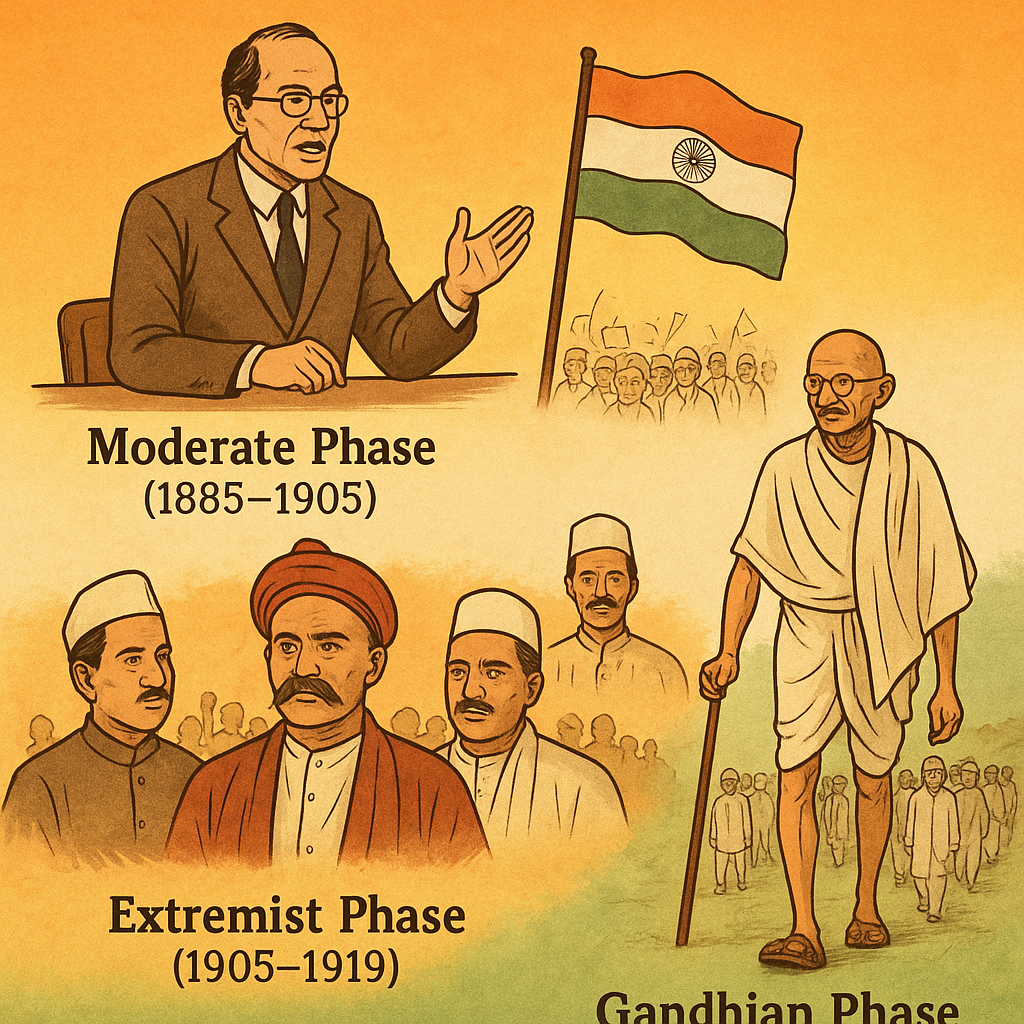
Champaran Satyagraha
(1917) was Mahatma Gandhi’s first civil disobedience movement in India,
launched against the exploitation of indigo farmers in Bihar. It marked the
beginning of the Gandhian era and introduced non-violent resistance as a
powerful political weapon in India’s freedom struggle.




Comments (0)
Leave a Comment