
Background
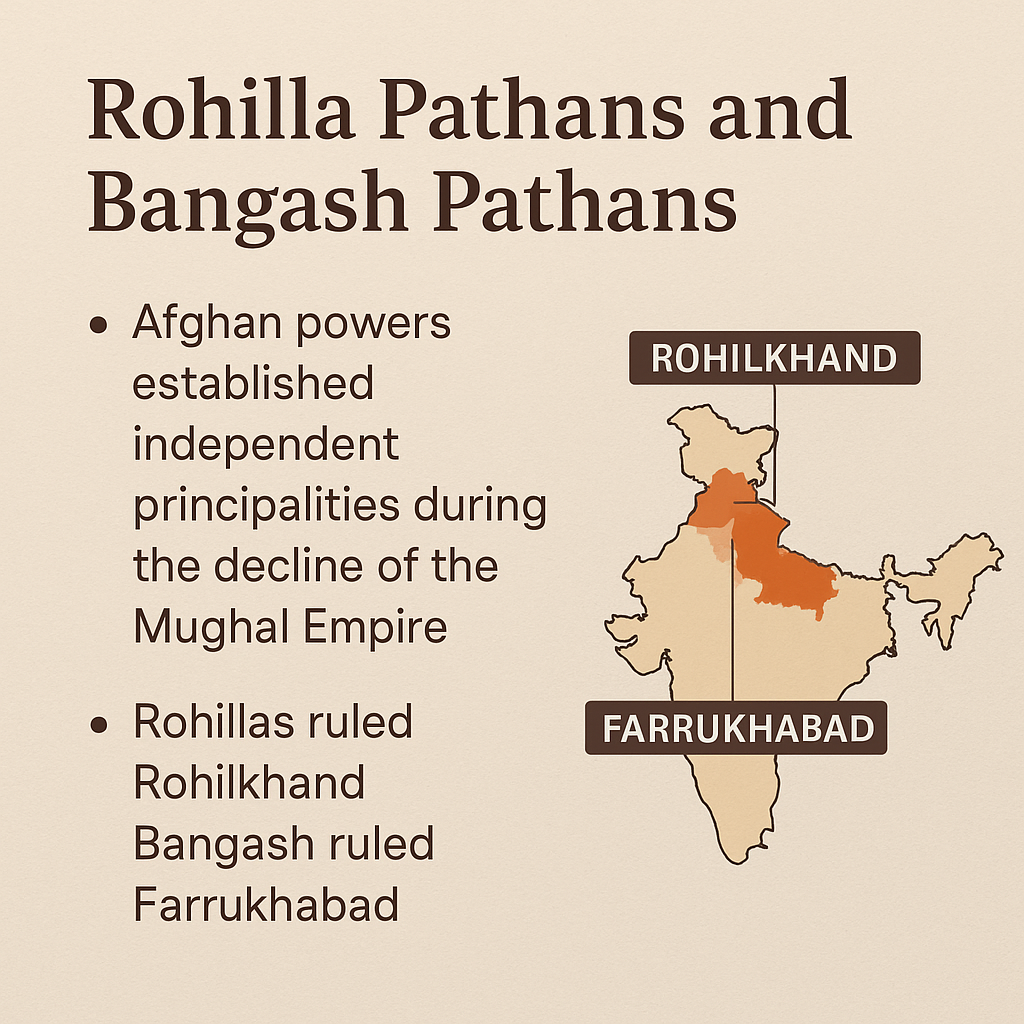
During the decline of the Mughal Empire in the 18th century, several regional Afghan powers emerged in northern India. Among the most prominent were the Rohilla Pathans (Ruhel Pathans) and the Bangash Pathans. These two Afghan groups played an important role in shaping regional politics and power dynamics during the transition from Mughal to British rule.
The Rohillas established control in the Rohilkhand region (modern Bareilly and Rampur areas), while the Bangash Pathans ruled the Farrukhabad area. Both groups were originally from Afghan tribal lineages and became influential through their military strength and administrative skill. Their rise marked the growing autonomy of provincial powers as the Mughal central authority weakened.
Important Facts for Prelims Exams
-
Rohilla Pathans were Afghan warriors who settled in the Rohilkhand region of present-day Uttar Pradesh.
-
Their leader Ali Mohammad Khan founded the independent Rohilla state.
-
The Bangash Pathans were another Afghan group who established themselves in Farrukhabad.
-
Their leader Mohammad Khan Bangash served under the Mughal Emperor Farrukhsiyar.
-
The Rohilla War (1774) was fought between the Rohillas and the Nawab of Awadh (Shuja-ud-Daula), assisted by the British.
-
After the war, Rohilkhand came under British control.
-
Both groups were known for their strong military culture and administrative capability.
-
These Pathans were part of the broader trend of Afghan influence in North India.
-
Their decline began with the rise of the British East India Company.
-
Their legacy remains significant in the political and cultural history of Uttar Pradesh.
Main Provisions and Key Facts
-
Rohilla Pathans (Ruhel Pathans)
-
Originated from the Afghan Roh region (modern Afghanistan and Pakistan).
-
Migrated to India during the later Mughal period.
-
Established control in the Rohilkhand region.
-
Founder: Ali Mohammad Khan (1708–1748).
-
Capital: Bareilly.
-
Fought against the Marathas and later against the Nawab of Awadh.
-
The Rohilla War (1774) ended their independence.
-
Later, Nawab Faizullah Khan founded Rampur State under British protection.
-
-
Bangash Pathans
-
Originated from the Bangash tribe of Afghanistan.
-
Settled in Farrukhabad (Uttar Pradesh).
-
Founder: Mohammad Khan Bangash (1665–1743).
-
Served as a Mughal commander and expanded influence in Bundelkhand and Awadh.
-
His son Qaim Khan and grandson Ahmad Khan continued to rule after him.
-
Their relations with Marathas were often hostile, leading to military conflicts.
-
Gradually, the Bangash power declined by the late 18th century.
-
Significance
-
Both Rohillas and Bangash Pathans symbolized the rise of regional powers in post-Mughal India.
-
They maintained Afghan traditions of governance, valor, and independence.
-
Their rise reflected the fragmentation of the Mughal Empire and the emergence of provincial autonomy.
-
The Rohilla War became a key event showing British intervention in Indian politics.
-
They influenced the socio-political structure of northern India, particularly in present-day Uttar Pradesh.
-
Their administrative centers, Bareilly and Farrukhabad, became important cultural and trade hubs.
Criticism or Limitations
-
Continuous internal rivalries among Afghan chiefs weakened their unity.
-
Their conflicts with neighboring powers like Awadh and Marathas led to loss of strength.
-
Lack of central coordination made them vulnerable to British diplomacy.
-
They failed to form lasting alliances with other Indian powers.
-
British expansion gradually ended their independence by the late 18th century.
Key Points for Exams
-
Founder of Rohilla Power: Ali Mohammad Khan (Bareilly, 18th century).
-
Founder of Bangash Power: Mohammad Khan Bangash (Farrukhabad).
-
Important War: Rohilla War, 1774.
-
Related Powers: Nawab of Awadh, British East India Company.
-
Decline: Late 18th century under British control.
-
Keywords: Rohilla Pathans, Bangash Pathans, Afghan tribes, Mughal decline, regional states.
In Short
The Rohilla and Bangash Pathans were Afghan powers who established independent principalities during the decline of the Mughal Empire. The Rohillas ruled Rohilkhand, and the Bangash ruled Farrukhabad. Both rose through military power but eventually lost autonomy due to conflicts and British expansion.



Comments (0)
Leave a Comment