
Introduction
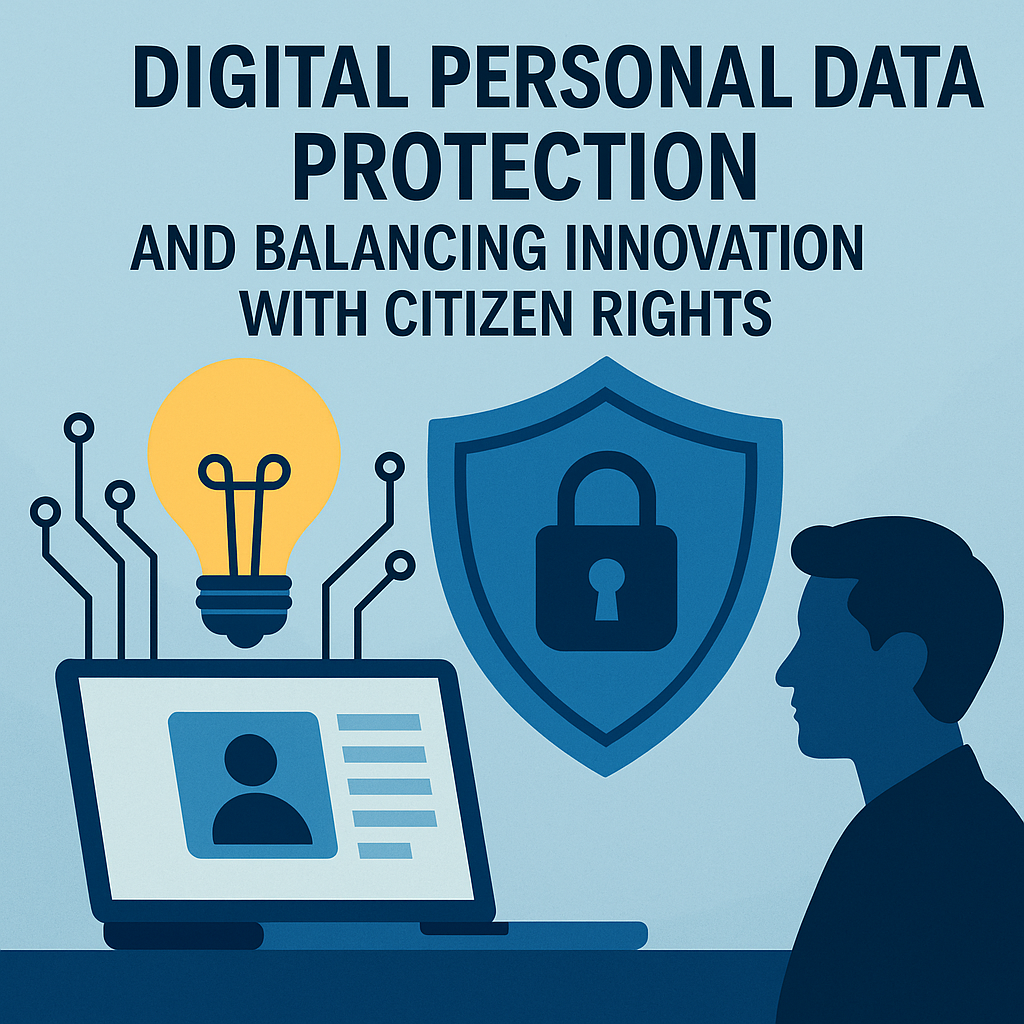
The rapid expansion of the digital economy in India has placed personal data at
the center of governance, innovation, and public trust. As citizens interact
with government platforms, private digital services, health systems, financial
applications, and social media networks, the quantity of personal information
collected is unprecedented. The challenge before India is to ensure that
digital progress does not undermine privacy, which is recognised as a
fundamental right under the constitutional framework. The Digital Personal Data
Protection Act of twenty twenty three represents India’s attempt to build a
lawful and transparent data ecosystem while sustaining the momentum of
innovation. The balance between economic growth and the protection of
individual rights is therefore a critical governance issue.
Background and Context
Concerns related to personal data governance became prominent in India after
the growth of Aadhaar based welfare delivery and the expansion of private
digital platforms. The Supreme Court held privacy to be a fundamental right in
twenty seventeen, which created a legal foundation for comprehensive data
protection. Expert committees examined global models such as the European Union
framework and suggested an Indian approach that supports digital
entrepreneurship while safeguarding citizens. Over years of debate, draft
versions of a data protection law underwent revisions to address compliance
burdens, cross border data flows, data fiduciary responsibilities, and
grievance mechanisms. This long policy journey reflects the attempt to harmonise
national priorities with citizen expectations.
Current Scenario
India’s digital population has crossed several hundred million users with rapid
adoption of smartphones, online payments, and government digital services.
Sectors such as health, fintech, e commerce, education technology, and mobility
services process sensitive information daily. Data breaches, identity theft,
financial fraud, and misuse of personal details continue to be reported,
reinforcing the need for robust safeguards. The Digital Personal Data
Protection Act twenty twenty three establishes obligations for data
fiduciaries, rights for data principals, grievance redress timelines, and
financial penalties for non compliance. It also recognises the importance of
innovation by allowing certain exemptions for research, public interest functions,
and state level requirements. The law is supported by the ongoing creation of
digital public infrastructure such as health stacks, agricultural platforms,
and digital identity tools, all of which require clear governance frameworks.
Government Policies and Legal Provisions
India’s approach to personal data protection is shaped by constitutional
guarantees, statutory measures, and sector specific regulations. The
constitutional right to privacy under the broader principles of liberty and
dignity forms the normative foundation. The Digital Personal Data Protection
Act twenty twenty three outlines rules for lawful processing, consent
requirements, purpose limitation, data minimisation, retention norms, and
safeguards for children. Sectoral guidelines exist in areas such as information
technology, financial regulation, and telecommunications. The Data Protection
Board is empowered to enforce compliance and adjudicate penalties. The
government also emphasises digital literacy and user awareness, recognising
that responsible citizen participation is essential for meaningful data
protection. Together, these elements form the core of India’s emerging data
governance architecture.
Challenges and Issues
First, India must balance ease of doing business with strong privacy
protections. Excessively strict rules may dampen start up innovation, while
weak protections could erode public trust.
Second, compliance costs remain a concern for micro, small, and medium
enterprises that handle personal data but lack technological resources.
Third, digital literacy is uneven, leaving many citizens unaware of their
rights, including consent withdrawal, correction of data, and grievance
procedures.
Fourth, data localisation debates continue, involving security considerations
on one hand and global business needs on the other.
Fifth, the widespread use of artificial intelligence tools raises questions
about algorithmic transparency, profiling risks, and fairness in automated
decision making.
Sixth, the state’s access to personal data for governance and security must
remain balanced with constitutional protections, judicial oversight, and
accountability norms.
Way Forward
India needs a multi dimensional strategy that strengthens privacy while
encouraging digital innovation. Clear rules, simplified compliance processes,
and sector wise guidance can support businesses without compromising citizen
rights. Technology driven safeguards such as encryption, anonymisation, and
secure storage standards must become routine across service providers. Citizens
must be empowered through awareness campaigns, school curriculum additions, and
simplified consent mechanisms. Independent oversight institutions must remain
transparent and accessible. Artificial intelligence systems should follow
principles of fairness, accountability, and explainability. International
cooperation frameworks can support secure cross border data transfers and
global best practices. By aligning technological growth with constitutional
values, India can build a trusted digital future.
Significance for Exams
For Prelims
Digital Personal Data Protection Act passed in twenty twenty three
Right to privacy recognised as a fundamental right in twenty seventeen
Data Protection Board established under the Act
Consent and purpose limitation are core principles of the law
Penalties for non-compliance can be significant under statutory provisions
Children’s data receives special protection
Digital public infrastructure is expanding across health, agriculture, and finance
For Mains
Balancing privacy with development is a governance challenge
The Act attempts to harmonise the ease of doing business with citizen rights
Artificial intelligence-based decision systems require accountability
Data protection is essential for national security as well as public trust
Digital literacy influences the effectiveness of privacy rights
For Interview
One must consider data protection as a balance between innovation and dignity
Strong safeguards build trust and encourage digital participation
Regulation should support startups while safeguarding citizens
Transparent institutions enhance public confidence in digital governance
In Short
India aims to create a safe and progressive digital ecosystem. Protecting
personal data while enabling innovation is essential for trust, growth, and
constitutional values






Comments (0)
Leave a Comment