
Introduction
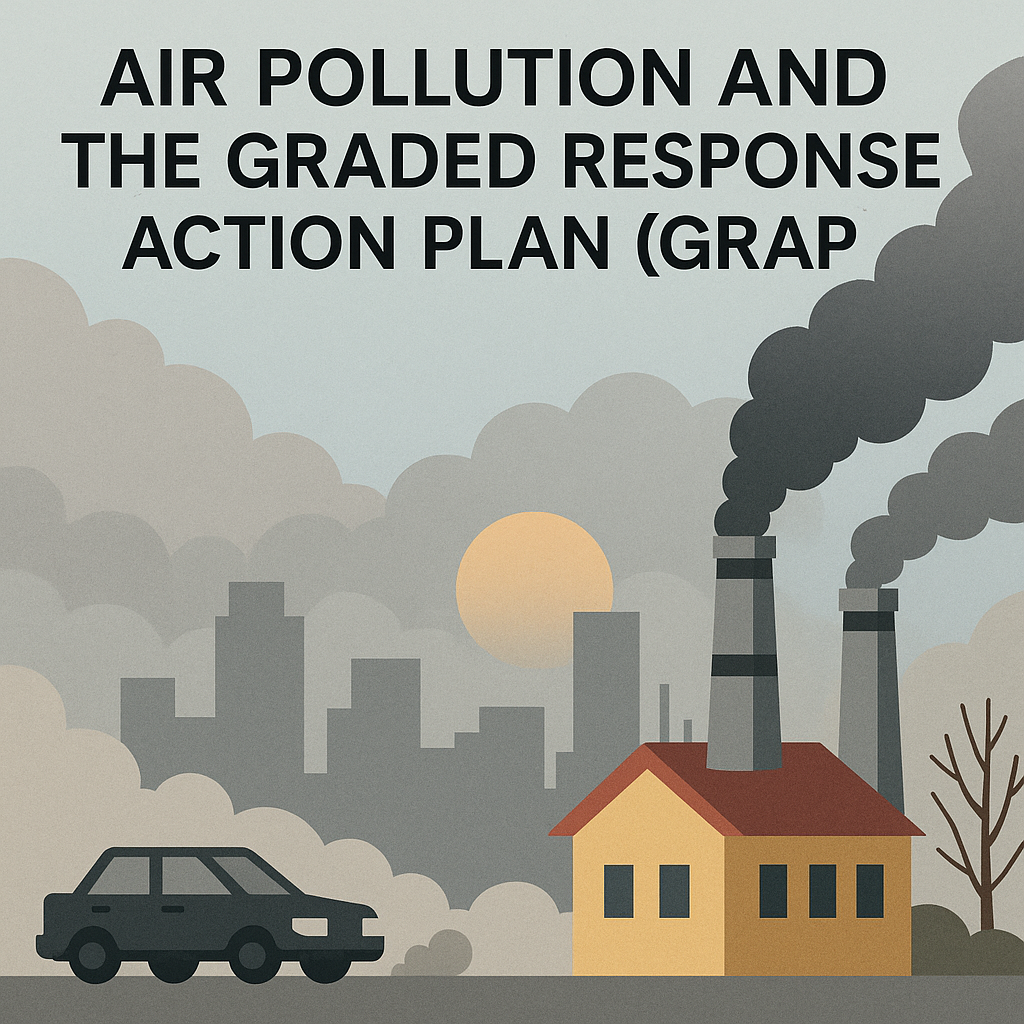
Air pollution in India has transcended the realm of an
environmental problem to become a profound developmental and public-health
challenge. The right to life under Article 21 of the Constitution inherently
includes the right to breathe clean air, and Article 48A and Article 51-A(g)
place a responsibility on the state and citizens respectively for protecting
the environment. Yet, many Indian cities witness sustained high levels of
particulate matter, leading to reduced life-expectancy, increased morbidity, and
compromised quality of life. In this context, the Graded Response Action Plan
(GRAP) was formulated to provide a structured and time-bound mechanism that
triggers specific measures when air-quality deteriorates beyond certain
thresholds. This editorial examines the genesis, current status, legal
framework, challenges and way forward for GRAP, situating it in India’s larger
quest for sustainable urbanisation and ecological governance.
Background & Context
India’s approach to air-quality management initially focused
on establishing ambient air quality standards, emission norms for industry and
vehicles, and urban air-quality monitoring networks. However, the episodic
nature of severe pollution—typified by smog events in winter, regional
transport of pollutants, and rapid escalation of particulate levels—revealed
that long-term norms alone were insufficient. In the National Capital Region
(NCR), recurrent pollution spikes during autumn-winter exposed the need for a
responsive system. Against this backdrop, the Graded Response Action Plan
(GRAP) was introduced for Delhi-NCR as an operational protocol based on Air
Quality Index (AQI) thresholds. The framework established multiple stages—each
invoking specific sets of regulatory and mitigation measures—thus enabling
authorities to act in a graded manner according to severity of pollution. Over
time, the responsibility for GRAP has been placed in the hands of the
Commission for Air Quality Management (CAQM) for the NCR and adjoining areas,
reflecting a shift toward adaptive and crisis-governance in the air-quality
domain.
Current Scenario
As of late 2025, the Delhi-NCR region continues to face
acute air-quality challenges. Monitoring data show persistent episodes where
the AQI exceeds the ‘Very Poor’ or even ‘Severe’ categories. For instance, on
the eve of Diwali in October 2025 the AQI in several stations crossed 300,
invoking Stage-II of GRAP in Delhi-NCR. Authorities responded by activating a
12-point plan under Stage-II, including suspension of construction,
restrictions on diesel generator sets and vehicle curbs. The national programme
for clean air—the National Clean Air Programme (NCAP)—has set a target of
reducing PM concentrations by up to 40 per cent or achieving national ambient
standards by 2025-26 in 131 cities. Despite efforts under NCAP and
implementation of GRAP-stages, many cities show slow progress. A review
indicates that out of the NCAP-designated cities, only a minority have achieved
significant reduction in PM10 concentrations. The frequent invocation of GRAP
in the NCR points to its dual interpretation: as a necessary emergency brake
and as a symptom of underlying structural failures in managing pollution
sources.
Government Policies & Legal Provisions
The GRAP framework is anchored in India’s environmental
policy and legal architecture. The Air (Prevention and Control of Pollution)
Act, 1981 empowers central and state pollution control boards to prescribe
standards and take measures to control air-pollution. The Environment
(Protection) Act, 1986 further provides broad powers to the Government to
protect and improve the environment, under which regulations and notifications
like GRAP can be issued. The National Clean Air Programme (NCAP), launched in
January 2019, enjoins non-attainment cities (131 in number) to prepare
city-specific action plans with the objective of reducing concentrations of
PM2.5 and PM10 by 20-30 per cent initially and later revised to up to 40 per
cent by 2025-26, relative to a 2017 baseline. GRAP sits within this ecosystem
as an operational mechanism in the NCR—linking AQI thresholds to prompt
actions. The activation of GRAP-Stage-II by CAQM in October 2025 for the
Delhi-NCR region is a case in point of the legal-policy link translated into
field implementation.
Challenges / Issues
- Structural
versus episodic responses: GRAP is inherently designed to respond to
acute condition of pollution. While that is valuable, it risks sidelining
the underlying structural sources—vehicular emissions, construction dust,
biomass burning—which demand long-term management rather than episodic
fixes.
- Multi-agency
coordination and enforcement: Effective implementation requires
seamless cooperation between municipal bodies, state pollution control
boards, transport departments and construction agencies. Fragmented
jurisdiction and delayed action undermine efficacy.
- Meteorology
and regional transport: In the NCR, local emissions are compounded by
stubble burning in adjacent states and adverse weather conditions. GRAP
cannot address these cross-boundary and meteorological variables directly,
yet they significantly drive pollution spikes.
- Scalability
of the model: GRAP has been tailored for the Delhi-NCR context.
Replicating similar stage-based response plans in other polluted cities
requires adaptation to local emission profiles, institutional capacities
and meteorological patterns.
- Equity
and livelihoods: The measures under GRAP—construction bans, vehicle
restrictions, generator curbs—can affect livelihoods of daily-wage
labourers, small contractors and drivers unless mitigated. Environmental
regulation thus must balance health protection and socioeconomic equity.
- Citizen
awareness and behaviour change: Many emergency measures demand public
cooperation—using public transport, avoiding open burning, curtailing
private vehicle use. Without sustained behaviour change, the effectiveness
of GRAP remains limited to top-down mandates.
Way Forward
To ensure GRAP evolves beyond being a mere emergency
stop-gap and becomes part of a sustainable air-quality governance ecosystem,
the following pathways merit attention:
- Embed
GRAP into a continuous governance framework so that responses are not
merely reactive but integrated with year-round monitoring, forecasting and
preventive interventions.
- Strengthen
institutional coordination by establishing a real-time data-sharing
dashboard across agencies—meteorology, transport, pollution boards, urban
local bodies—so that decisions under GRAP are triggered with speed and
clarity.
- Scale
the GRAP concept to other cities under NCAP by tailoring graded action
plans to local contexts—source profiles, meteorology, institutional
capacity—and ensuring local ownership.
- Focus
on structural source reduction: accelerate electric-mobility adoption,
upgrade public transport, enforce construction-dust management,
incentivise clean agriculture practices like residue management to reduce
stubble burning.
- Incorporate
livelihood support into action plans: when construction bans or vehicle
curbs are invoked, provide alternative scheduling, compensation or social
protection to affected workers so that health goals and equity go hand in
hand.
- Promote
citizen engagement and behavioural change through sustained awareness
campaigns, school programs, real-time public air-quality information, and
behavioural nudges to reduce private vehicle use and open burning.
- Establish
a system of monitoring, review and adaptive learning: periodic audits of
GRAP activations, outcome assessments, feedback loops and revision of
stage thresholds based on experience and technology advancements.
Significance for Exams
For Prelims
- The
National Clean Air Programme (NCAP) launched in 2019 targeting up to 40
per cent reduction in PM10 by 2025-26.
- GRAP
implementation in Delhi-NCR, with Stage-II invoked in October 2025 when
AQI crossed 300.
- Legal
basis: Air (Prevention and Control of Pollution) Act, 1981 and Environment
(Protection) Act, 1986.
- Defined
AQI thresholds for GRAP in Delhi-NCR: e.g., Stage-I for AQI 201-300,
Stage-II for AQI 301-400.
- 131
non-attainment cities under NCAP required to prepare action plans.
- Evidence
that fine particulate pollution (PM2.5) reduces average life expectancy by
over 5 years in India.
- 12-point
action plan under GRAP Stage-II in Delhi-NCR as of October 2025.
For Mains
- GRAP
as an exemplar of adaptive governance linking environmental thresholds to
operational response.
- The
interplay of local emissions, regional transport (agricultural residue
burning) and meteorology in urban air pollution—an integrated challenge.
- Role
of institutional architecture: CAQM, municipal agencies, pollution control
boards, integrated data systems.
- Equity
dimension of environmental regulation: balancing urgent health imperatives
with livelihoods and economic activity in urban-construction sectors.
- The
scalability challenge: transferring the GRAP model from Delhi-NCR to other
Indian cities under NCAP.
- Behavioural
change and citizen participation as critical enablers of effective
air-quality governance.
For Interview
- GRAP
shows that environmental regulation cannot be purely preventive;
crisis-responsive frameworks are essential in fast-changing urban
contexts.
- While
GRAP ensures prompt action, true success lies in embedding such mechanisms
into structural reform of transport, industry and agriculture.
- Citizens
are not mere recipients of top-down orders; sustainable clean air requires
them as active participants in reducing emissions and supporting
governance.
- The
model of graded response could serve other domains of environmental
policy—urban flood management, heat-wave response and disaster
governance—highlighting the value of stage-based governance.
In Short
The Graded Response Action Plan has introduced a structured,
threshold-based operational layer to India’s air-quality management system.
Yet, for sustained improvement in clean air, the focus must shift from episodic
crisis interventions to long-term structural reforms, institutional
coordination, citizen behaviour change and equity-sensitive governance.


Comments (0)
Leave a Comment