
Background
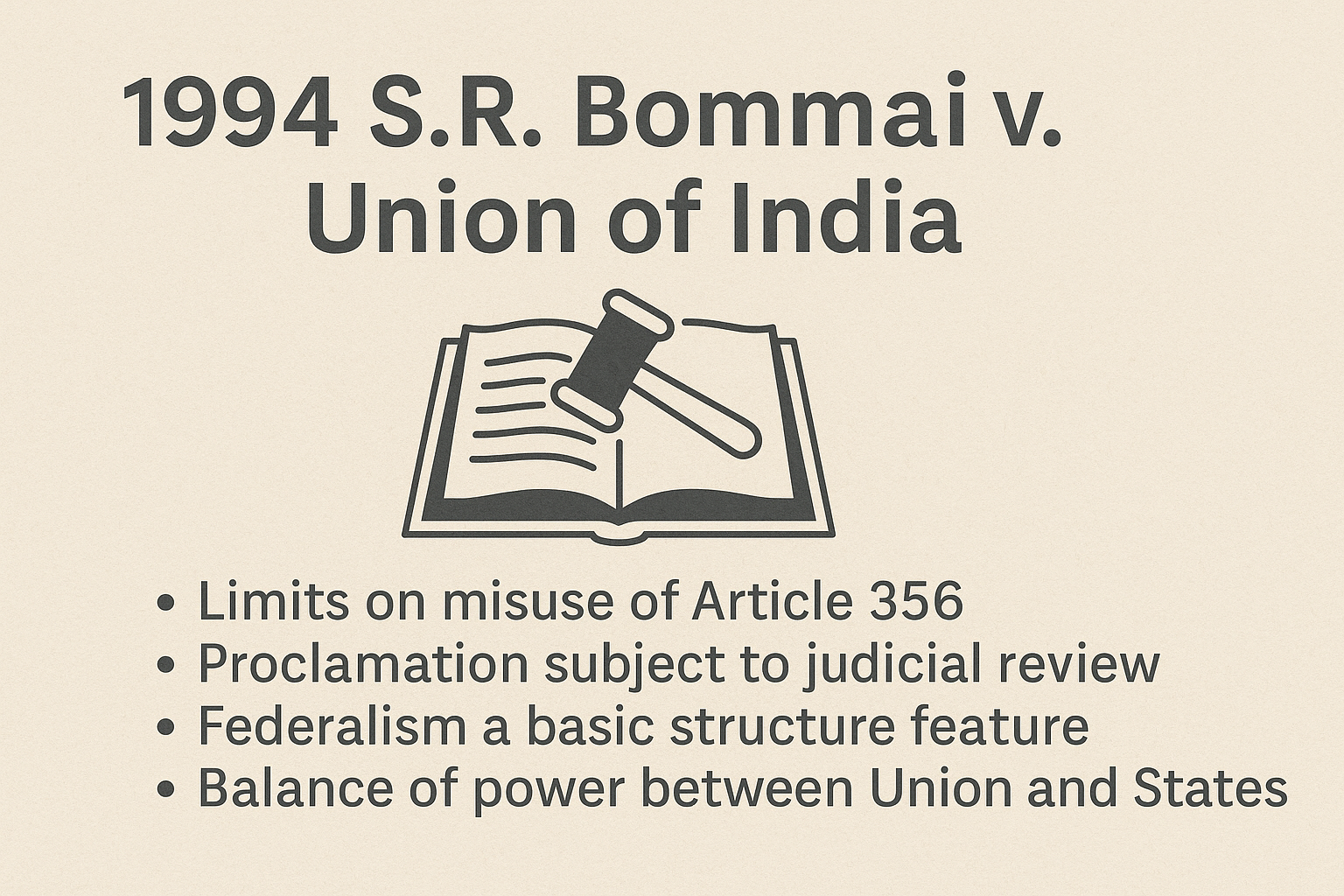
The S. R. Bommai v. Union of India case (1994) is one of the most important judgments in Indian constitutional history. It dealt with the scope and limits of the President's power under Article 356 of the Indian Constitution, which allows the President to impose President’s Rule in a state when the constitutional machinery fails.
This case arose when the Janata Dal government in Karnataka, led by S. R. Bommai, was dismissed by the Governor in 1989. The dismissal was based on the Governor’s report claiming that Bommai had lost the majority in the Legislative Assembly. Bommai challenged the dismissal in the Supreme Court, leading to a landmark decision that defined the true spirit of federalism and limited the arbitrary use of Article 356.
Important Facts for Prelims Exams
-
Year of Judgment: 1994
-
Bench: Nine-judge Constitution Bench
-
Article Involved: Article 356 (President’s Rule)
-
Main Issue: Misuse of Article 356 and scope of judicial review
-
Key Principle: Federalism is a basic feature of the Constitution
-
Court: Supreme Court of India
-
Judgment Delivered On: March 11, 1994
-
Chief Justice: A. M. Ahmadi (part of the bench)
-
Related Cases: Rameshwar Prasad v. Union of India (2006) followed this principle
-
Type of Judgment: Landmark constitutional interpretation
Main Provisions and Key Facts
-
The Supreme Court ruled that the proclamation of President’s Rule under Article 356 is subject to judicial review.
-
The Court stated that the President’s satisfaction under Article 356 is not beyond scrutiny and can be examined by courts to prevent misuse.
-
If a government loses majority, it must be tested on the floor of the Legislative Assembly, not decided by the Governor alone.
-
The Court emphasized that the power under Article 356 must be used only as a last resort.
-
The decision made it clear that federalism is part of the basic structure of the Constitution.
-
The judgment also laid down that once the President’s Rule is imposed, if found unconstitutional, the dismissed government can be restored.
-
The Court struck a balance between the Union’s power and the State’s autonomy, reinforcing cooperative federalism.
-
The judgment restricted political misuse of Article 356 by the central government.
-
It directed that every Article 356 proclamation must be placed before both Houses of Parliament for approval.
-
The verdict strengthened democratic accountability and limited executive overreach.
Significance
-
The Bommai case marked a turning point in Indian constitutional law.
-
It protected the federal balance between the Union and the States.
-
It reinforced the concept that the Governor must act impartially and within constitutional limits.
-
The case established that the judiciary has the authority to review the imposition of President’s Rule.
-
It prevented the central government from arbitrarily dismissing state governments for political reasons.
-
It ensured that democracy and federalism remain the core principles of Indian governance.
-
This case also influenced later judgments related to Centre-State relations.
Criticism or Limitations
-
Some critics believe the guidelines are interpretive rather than enforceable laws.
-
The judgment depends on post-facto judicial review, meaning that unconstitutional actions can still occur before correction.
-
The role of the Governor, though clarified, still remains controversial in political contexts.
-
Despite Bommai, instances of Article 356 misuse have occurred occasionally.
Key Points for Exams
-
Year: 1994
-
Article: 356
-
Bench Strength: Nine Judges
-
Related Principles: Federalism, Basic Structure Doctrine, Judicial Review
-
Related Case: Rameshwar Prasad (2006)
-
Importance: Restriction on misuse of Article 356
-
Outcome: Strengthened democratic federalism and judicial oversight
In Short
The S. R. Bommai case of 1994 reaffirmed that India is a federal democracy. It limited the misuse of Article 356 and empowered the judiciary to review presidential proclamations, ensuring that political power remains accountable to the Constitution.
Comments (0)
Leave a Comment