
Background
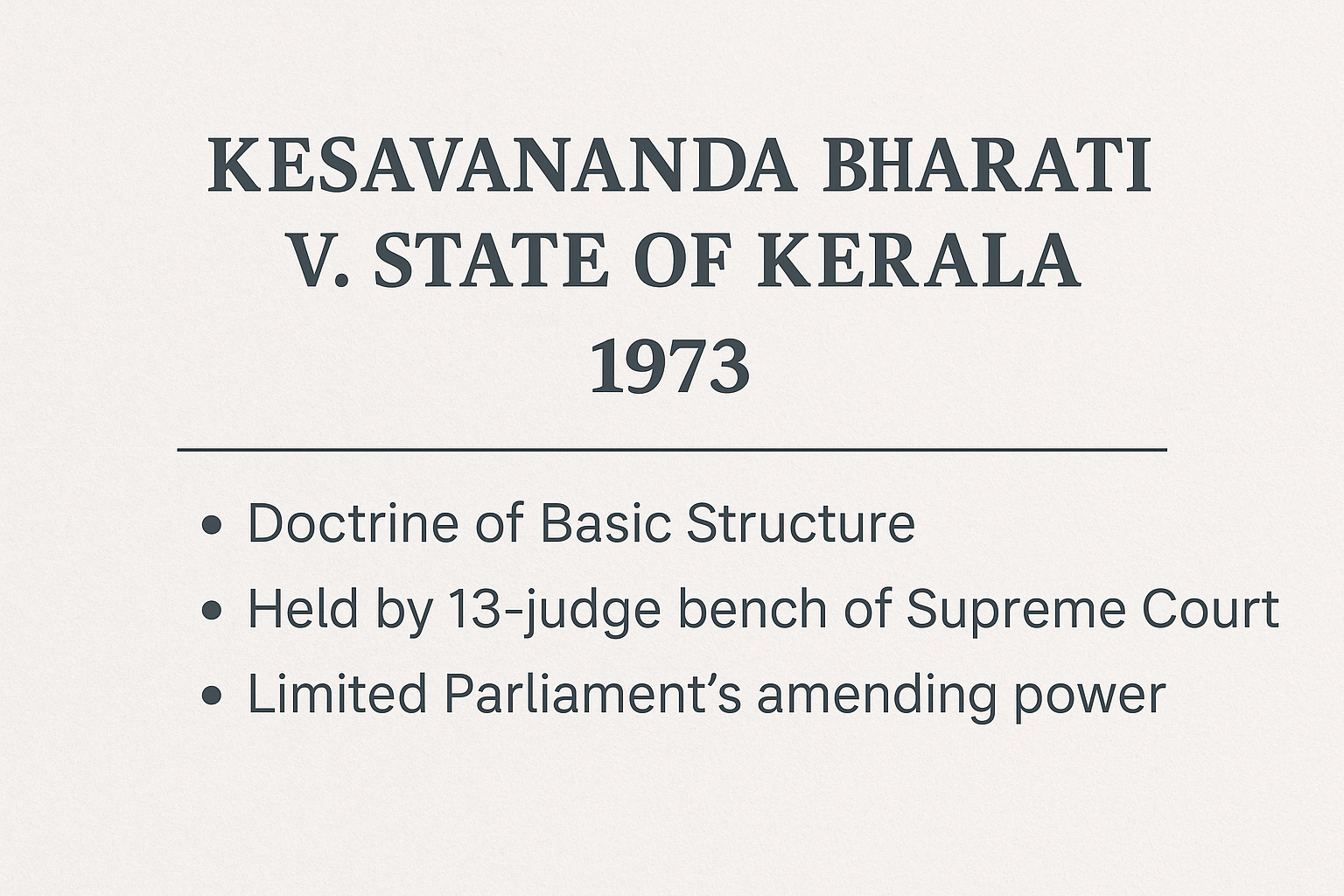
The Kesavananda Bharati v. State of Kerala case (1973) is one of the most significant constitutional judgments in Indian history. It arose when Kesavananda Bharati, the head of Edneer Mutt in Kerala, challenged the Kerala Land Reforms Act of 1969. He claimed that the Act violated his fundamental rights to manage his religious property under Articles 25, 26, and 31 of the Constitution. The case eventually expanded into a constitutional debate on the power of Parliament to amend the Constitution itself.
At that time, Parliament had passed several amendments, including the 24th, 25th, and 29th Amendments, which sought to give Parliament unlimited power to amend any part of the Constitution, even Fundamental Rights. The Supreme Court was thus required to determine whether there were any limits on Parliament's power to amend the Constitution.
Important Facts for Prelims Exams
-
Year of Judgment: 1973
-
Bench Strength: 13 judges (largest ever in Indian judicial history)
-
Chief Justice: S. M. Sikri
-
Key Articles involved: Article 13, Article 31, and Article 368
-
Related Amendments: 24th, 25th, and 29th Constitutional Amendments
-
Outcome: Introduced the "Basic Structure Doctrine"
-
Majority: 7 judges; Minority: 6 judges
-
Petitioner: Kesavananda Bharati (head of Edneer Mutt, Kasaragod, Kerala)
-
Respondent: State of Kerala
-
Duration: Arguments lasted 68 days
Main Provisions and Key Facts
-
The petitioner challenged the validity of the 24th, 25th, and 29th Constitutional Amendments.
-
These amendments aimed to give Parliament unrestricted power to amend the Constitution, including Fundamental Rights.
-
The Supreme Court, in a 7:6 judgment, held that while Parliament has wide powers under Article 368 to amend the Constitution, it cannot alter the basic structure or framework.
-
The Court clarified that the term "amendment" does not mean the power to destroy or abrogate the Constitution.
-
The Basic Structure Doctrine emerged from this judgment, which became a permanent part of Indian constitutional law.
-
The Court did not define an exhaustive list of basic features but mentioned several examples such as the supremacy of the Constitution, rule of law, separation of powers, judicial review, and secularism.
-
This doctrine acts as a limitation on the amending powers of Parliament to preserve the fundamental identity of the Constitution.
-
The judgment also balanced the relationship between Parliament and the judiciary, ensuring neither absolute supremacy of Parliament nor judicial overreach.
-
Justice H. R. Khanna played a crucial role in forming the decisive majority opinion that upheld limited amending power.
-
The case reaffirmed that the Constitution is not merely a legal document but a living framework that ensures democracy and liberty.
Significance
-
The Kesavananda Bharati case established that Parliament cannot change the essential features of the Constitution.
-
It protected Fundamental Rights from total erosion through constitutional amendments.
-
The doctrine strengthened judicial review and reinforced the independence of the judiciary.
-
It maintained a balance between flexibility and stability in the Constitution.
-
The judgment ensured that the Indian Constitution remains the supreme law and that its democratic and republican character cannot be destroyed by temporary political majorities.
Criticism or Limitations
-
The Basic Structure Doctrine was not clearly defined, leaving ambiguity about which features are "basic".
-
Critics argue that it allows the judiciary excessive interpretive power over elected representatives.
-
The narrow margin of the 7:6 verdict showed deep divisions even within the Supreme Court.
-
Later cases like Indira Nehru Gandhi v. Raj Narain (1975) and Minerva Mills v. Union of India (1980) had to clarify and expand the doctrine further.
Key Points for Exams
-
Year: 1973
-
Case: Kesavananda Bharati v. State of Kerala
-
Bench: 13 judges
-
Ratio: 7:6
-
Chief Justice: S. M. Sikri
-
Petitioner: Kesavananda Bharati
-
Doctrine Established: Basic Structure Doctrine
-
Articles: 13, 31, 368
-
Related Amendments: 24th, 25th, 29th
-
Related Cases: Golaknath (1967), Indira Gandhi (1975), Minerva Mills (1980)
In Short
The Kesavananda Bharati judgment of 1973 introduced the Basic Structure Doctrine, limiting Parliament's power to amend the Constitution. It ensured that essential principles like democracy, rule of law, and judicial independence remain intact, preserving the spirit of the Constitution for future generations.



Comments (0)
Leave a Comment