
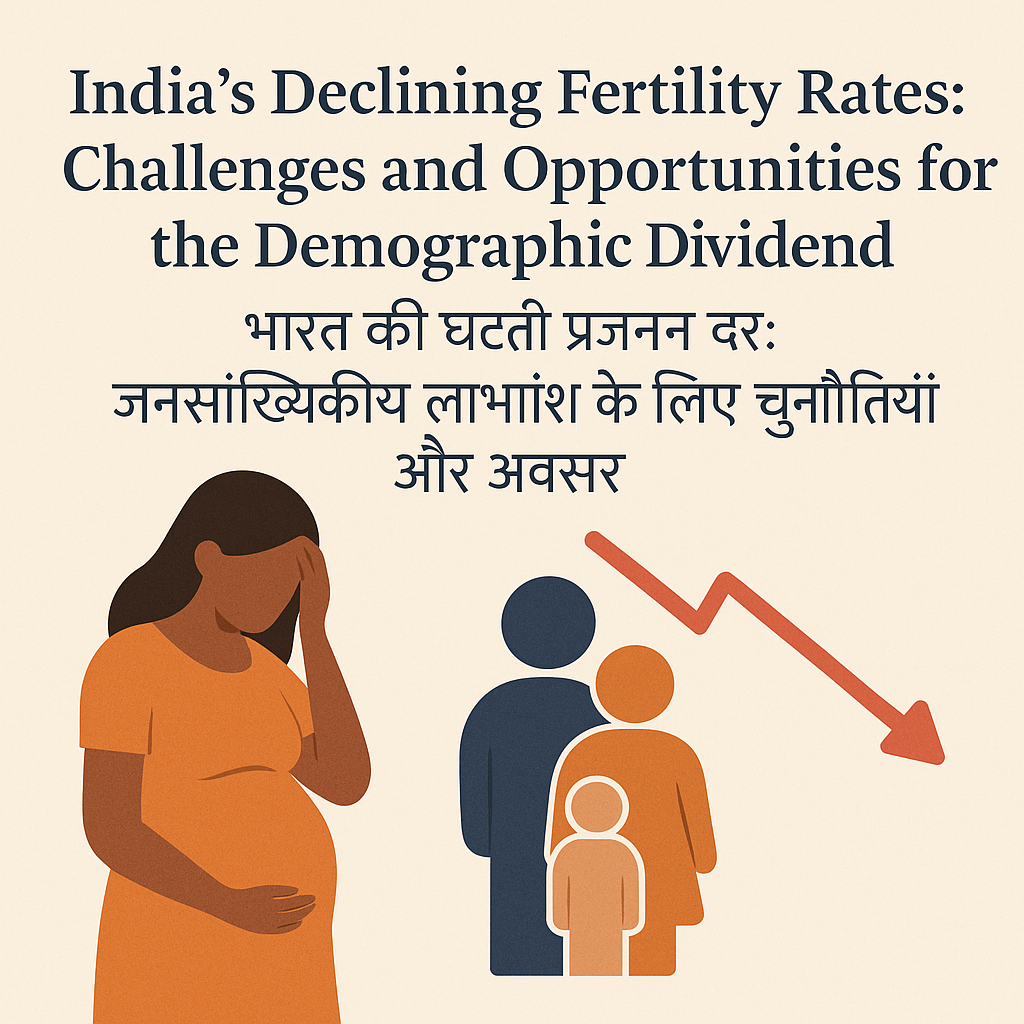
Introduction
India, once known for its population explosion, is now witnessing a steady
decline in fertility rates. This demographic shift marks a crucial turning
point in the country’s developmental trajectory. The fertility rate, defined as
the average number of children a woman bears during her lifetime, is an
essential indicator of population growth and socioeconomic change. According to
the National Family Health Survey (NFHS-5), India’s total fertility rate (TFR)
dropped to 2.0 in 2021, below the replacement level of 2.1. This signals that
India’s population has started stabilizing, a trend usually seen in developed
economies. The Constitution of India, through its Directive Principles,
emphasizes improving public health, family welfare, and the standard of living
— objectives directly influenced by demographic patterns. As India enters the
final phase of its demographic dividend window, understanding the implications
of declining fertility rates is vital for policymakers, economists, and civil
service aspirants alike.
Background & Context
At the time of Independence, India’s TFR was around 5.9, and
rapid population growth was a major developmental concern. The 1952 National
Family Planning Programme made India the first country in the world to launch
an official population policy. Over the decades, measures such as awareness
campaigns, improved access to contraceptives, maternal healthcare, and literacy
expansion helped in reducing fertility rates. The shift from “population
control” to “reproductive health and family welfare” in the 1990s, guided by
the Cairo Conference on Population and Development, marked a major policy
transition.
Urbanization, female education, declining child mortality, and changing
aspirations have accelerated the decline. India’s demographic journey thus
reflects its socio-economic transformation from a high fertility, high
mortality society to one aiming for sustainable population stabilization and
improved quality of life.
Current Scenario
According to NFHS-5 (2019–21), India’s TFR stands at 2.0, a
significant decline from 3.4 in 1992–93 and 2.2 in 2015–16. Eighteen states and
union territories now have fertility rates below replacement level, including
Kerala, Tamil Nadu, Punjab, Maharashtra, and Delhi. However, states like Bihar
(2.9), Uttar Pradesh (2.4), and Meghalaya (2.9) continue to have higher
fertility levels.
This regional imbalance highlights India’s demographic diversity. The United
Nations Population Fund (UNFPA) projects that India’s population will peak
around 2064 before gradually declining. The country’s median age is currently
around 28 years, expected to rise to 38 by 2050. This implies a shrinking youth
cohort and a growing elderly population.
While a lower fertility rate reduces pressure on natural resources,
infrastructure, and public services, it also raises concerns about future labor
shortages, social security costs, and the sustainability of the demographic
dividend that has powered India’s growth since the 2000s.
Government Policies & Legal Provisions
- National Population Policy (2000): Aims for population stabilization by 2045 through voluntary and informed choice.
- National Health Policy (2017): Focuses on reproductive, maternal, newborn, child, and adolescent health.
- Mission Parivar Vikas (2016): Targets high fertility districts to improve access to family planning services.
- Janani Suraksha Yojana & POSHAN Abhiyaan: Promote safe motherhood and nutrition for women and children.
- Constitutional Basis: Article 47 directs the State to improve public health and standard of living.
- Pradhan Mantri Matru Vandana Yojana: Provides financial incentives for institutional deliveries and maternal care.
These initiatives collectively aim to balance population stabilization with health, gender equality, and human capital development.
Challenges / Issues
- Regional Disparities: Fertility rates vary sharply across states, reflecting uneven progress in literacy, income, and healthcare access.
- Gender and Societal Norms: Preference for male children, early marriages, and patriarchal attitudes persist in many regions.
- Declining Workforce: A faster-than-expected fertility decline may lead to labor shortages, especially in manufacturing and agriculture.
- Aging Population: The proportion of elderly citizens is projected to rise from 10 percent in 2021 to 20 percent by 2050, increasing pension and healthcare burdens.
- Health and Education Gaps: Many women still lack access to reproductive healthcare and quality education, limiting informed family planning.
- Economic Implications: A shrinking working-age population could impact savings, productivity, and long-term growth.
Way Forward
- Focus on Human Capital: Strengthen education, skills, and health to enhance productivity and offset a smaller workforce.
- Women Empowerment: Delay in marriage and childbearing through education and employment opportunities can balance fertility patterns.
- Regional Approach: Tailor population policies to specific state needs — fertility reduction in high-TFR states and family support in low-TFR states.
- Elderly Care Framework: Develop long-term pension, insurance, and healthcare mechanisms to support an aging population.
- Promote Inclusive Growth: Encourage labor participation, especially among women, to maintain demographic strength.
- Public Awareness and Incentives: Encourage voluntary family planning and responsible parenthood without coercive measures.
India must shift from population control to population management — ensuring that every child born is healthy, educated, and productive.
Significance for Exams
For Prelims:
- NFHS-5 (2019–21) reports India’s TFR at 2.0.
- Replacement level fertility is 2.1.
- National Population Policy launched in 2000.
- Mission Parivar Vikas launched in 2016.
- Article 47 relates to public health and nutrition.
- India’s median age is 28 years (2024).
- Population projected to peak around 2064.
For Mains:
- Analyze how declining fertility affects India’s demographic dividend.
- Evaluate regional disparities in fertility and their developmental impact.
- Discuss policy challenges in balancing workforce demand and aging population.
- Suggest measures to utilize human capital effectively in a low fertility scenario.
For Interview:
- What are the implications of India reaching below-replacement fertility?
- How can India prepare for an aging society?
- Should the government adopt pro-natalist policies in the future?
In Short
India’s fertility decline marks a demographic milestone, offering both relief and responsibility. While it can ease population pressures, it also calls for new strategies to maintain economic momentum and care for an aging population. The future of India’s demographic dividend will depend not on numbers, but on the quality of its human capital.





Comments (0)
Leave a Comment