
Introduction
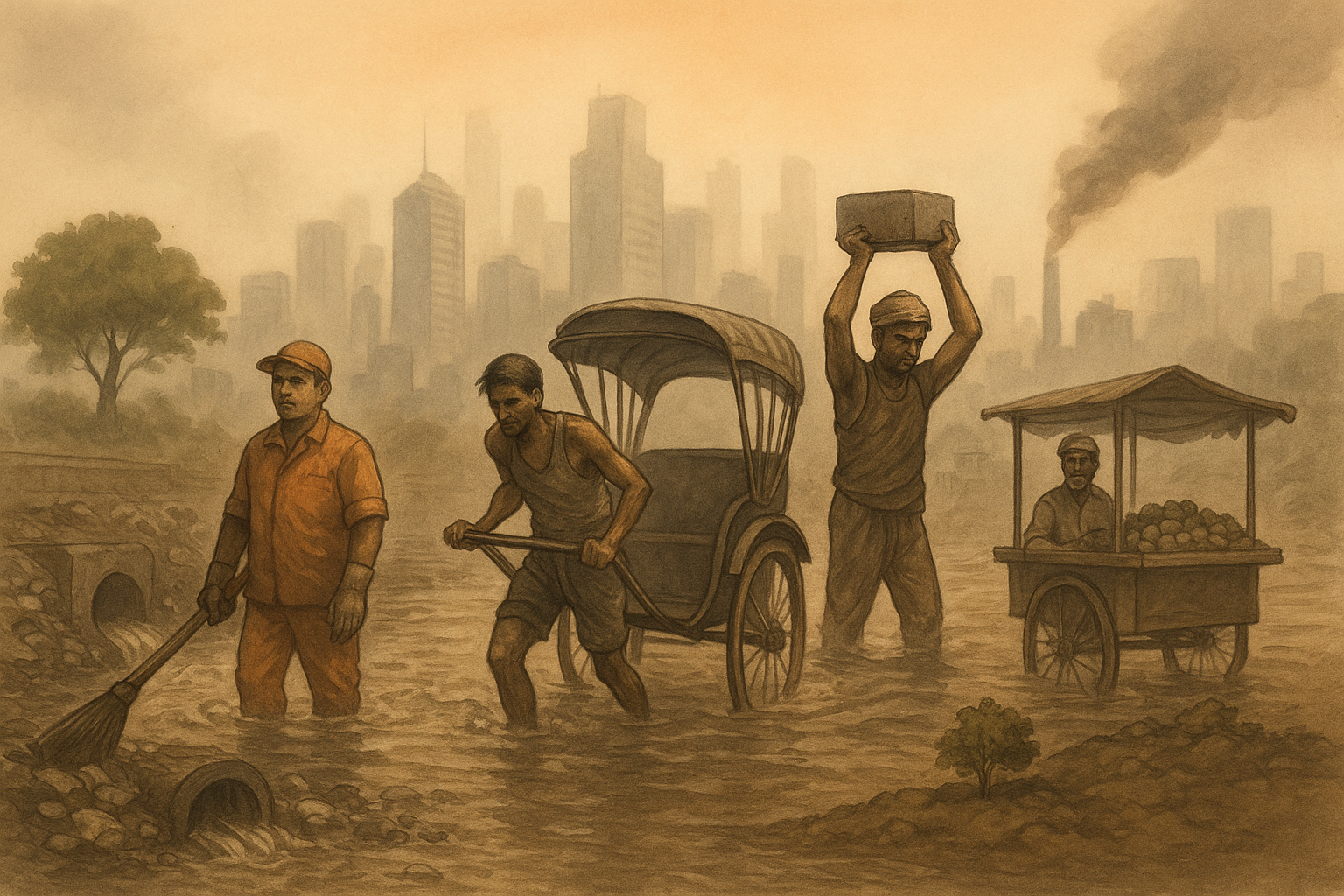
India’s rapid urbanisation has created new challenges of sustainability, inclusion, and climate resilience. The rise of “eco-precariat” — a term referring to vulnerable urban workers whose livelihoods are directly affected by environmental degradation and climate shocks — highlights the intersection of poverty, governance, and ecological stress. In Indian cities like Delhi, Mumbai, and Chennai, increasing heat waves, floods, and air pollution have made living conditions unliveable for millions. The issue links closely with Article 21 of the Constitution (Right to Life) and Article 48A (Protection of Environment), emphasizing the duty of the State to ensure livable urban conditions.
Background and Context
The term “precariat” originally described insecure workers in globalised economies. “Eco-precariat” extends this idea to people facing environmental insecurity due to urban ecological stress. Historically, India’s cities developed under colonial and industrial planning models that ignored environmental balance. Post-independence, urban policies focused on economic growth and industrialisation rather than sustainability. The 74th Constitutional Amendment Act (1992) mandated urban local bodies for participatory governance, but environmental concerns remained secondary.
With rising climate risks, informal sector workers, slum dwellers, sanitation staff, and construction labourers have become the face of the eco-precariat. They often live in unsafe housing near polluted rivers, garbage dumps, or flood-prone areas, making them highly vulnerable to both livelihood loss and health hazards.
Current Scenario
As per the IPCC and NITI Aayog reports, Indian cities are among the most climate-vulnerable in the world. Delhi’s air quality index often exceeds 400, while Chennai and Mumbai experience recurrent urban floods. The World Bank (2023) estimated that by 2030, climate change could push 50 million Indians into poverty. Urban poor communities are least responsible for emissions but face the worst consequences.
Municipal infrastructure remains inadequate — with 70 percent of urban sewage untreated, groundwater depletion accelerating, and solid waste mismanagement worsening air and soil pollution. Informal workers in waste recycling, rickshaw pulling, street vending, and construction are exposed to extreme heat, toxic air, and economic uncertainty. Their struggles represent the human cost of unplanned urbanisation and climate neglect.
Government Policies and Legal Provisions
Several constitutional and policy instruments address urban and environmental concerns.
-
Article 21 ensures Right to a clean and healthy environment.
-
Article 48A and Article 51A(g) emphasize protection of the environment as both state and citizen duty.
-
The National Action Plan on Climate Change (NAPCC) and its eight missions include the National Mission on Sustainable Habitat.
-
The Atal Mission for Rejuvenation and Urban Transformation (AMRUT), Smart Cities Mission, and Swachh Bharat Mission aim to improve infrastructure and sanitation.
-
The National Green Tribunal (NGT) and Environment Protection Act, 1986, strengthen legal oversight.
However, the implementation gap remains wide, and marginalized groups often remain excluded from decision-making and benefits.
Challenges and Issues
-
Inadequate Urban Governance – Weak municipal capacities, overlapping jurisdictions, and lack of accountability hinder climate-sensitive planning.
-
Exclusion of Informal Workers – Policies rarely recognise the rights and needs of waste pickers, hawkers, and daily wage earners.
-
Infrastructure Inequality – Elite urban spaces receive investment, while informal settlements remain under-served.
-
Climate-Induced Migration – Displacement due to floods, droughts, or heat stress increases urban vulnerability.
-
Lack of Data and Participation – Absence of inclusive climate vulnerability mapping limits policy response.
-
Environmental Health Burden – Air, water, and noise pollution disproportionately affect poor communities.
Way Forward
-
Strengthen local urban bodies through fiscal and functional decentralisation as per the 74th Amendment.
-
Adopt participatory climate-resilient planning with representation from slum dwellers and informal workers.
-
Promote green jobs and skill development under missions like Green India and National Skill Development Mission.
-
Improve urban housing, waste management, and drainage infrastructure through convergence of AMRUT, SBM, and Smart Cities schemes.
-
Integrate climate adaptation into city master plans and municipal budgets.
-
Encourage data-driven governance using GIS mapping and citizen dashboards.
Significance for Exams
For Prelims
-
74th Constitutional Amendment Act – 1992
-
National Action Plan on Climate Change – 2008
-
Environment Protection Act – 1986
-
Atal Mission for Rejuvenation and Urban Transformation (AMRUT) – 2015
-
Smart Cities Mission – 2015
-
Swachh Bharat Mission – 2014
-
National Green Tribunal Act – 2010
-
Article 48A – Directive Principle on Environment
For Mains
-
The eco-precariat reflects the failure of inclusive urban governance under climate stress.
-
Participatory planning and decentralisation are key to sustainable cities.
-
Green job creation can balance economic growth and ecological justice.
-
Integration of urban poverty alleviation with climate adaptation enhances resilience.
-
Case example: Chennai floods (2015) and Delhi pollution crisis highlight the need for systemic change.
For Interview
-
Sustainable urbanisation must focus on people as much as on infrastructure.
-
Climate justice demands inclusion of vulnerable communities in urban planning.
-
The idea of eco-precariat urges policymakers to view environment and livelihood as interdependent.
-
Livable cities are fundamental to constitutional values of dignity and equality.
In Short
The struggles of eco-precariat in India’s unliveable cities expose the urgent need for inclusive and climate-sensitive urban governance. Ensuring sustainability with equity is not only an environmental goal but also a constitutional and moral responsibility.

Comments (0)
Leave a Comment