
Introduction
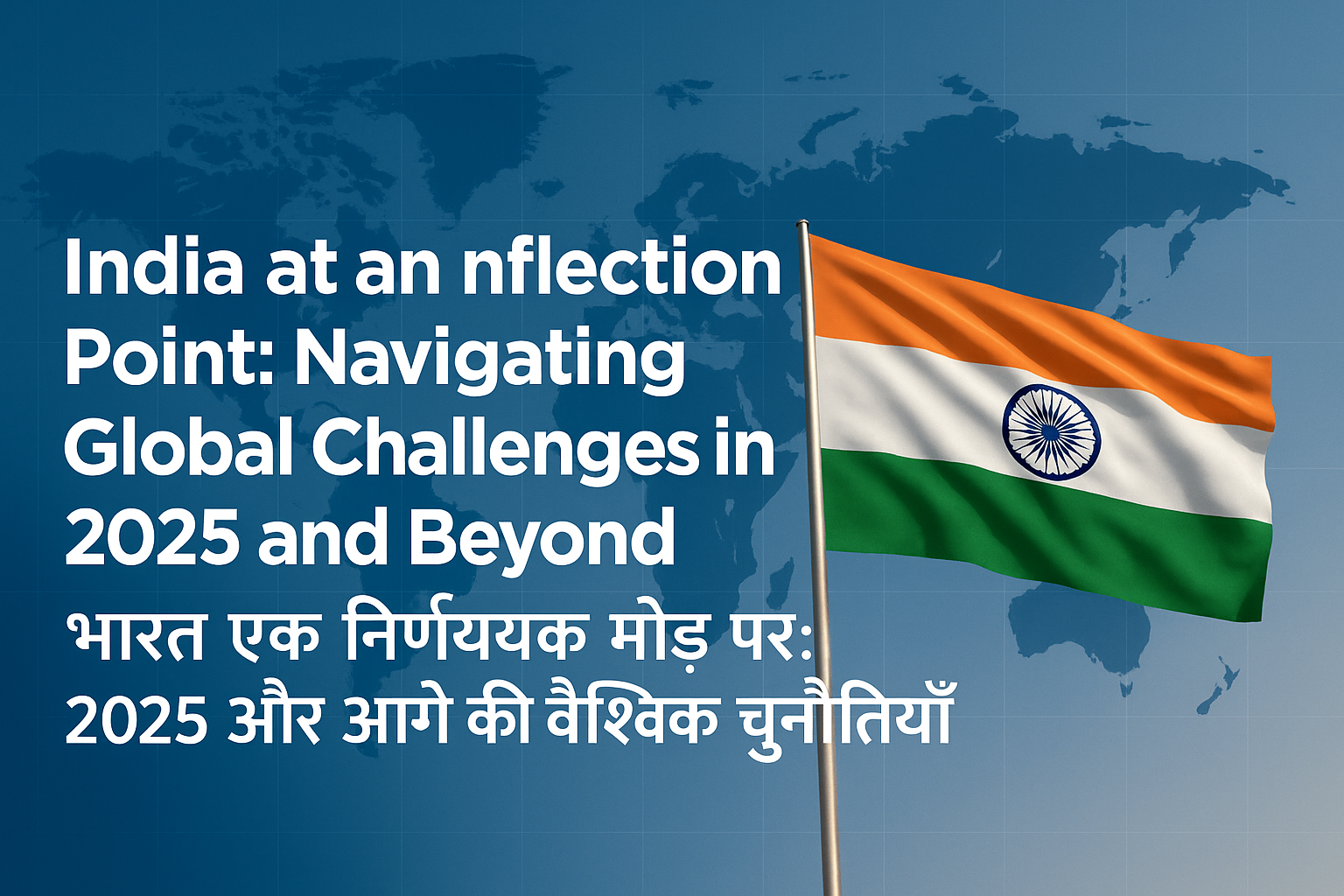
India stands today at a critical juncture in its national journey. With a rapidly transforming global order, economic uncertainty, and technological disruptions, the country’s development path requires calibrated policy responses. The term "inflection point" refers to a decisive stage when small changes can lead to major transformations. In 2025 and beyond, India faces opportunities to rise as a global power, but it must also overcome challenges in areas like economic resilience, environmental sustainability, geopolitical alignment, and social inclusivity. The issue is directly linked to the constitutional vision of justice, liberty, equality, and fraternity as enshrined in the Preamble of India’s Constitution.
Background and Context
Historically, India’s policy evolution has reflected adaptation to global realities. The early decades after independence focused on nation-building through a mixed economy and democratic consolidation. The 1991 economic reforms marked another turning point, integrating India into the global market system. In the 21st century, the rise of digital governance, green growth, and global partnerships have reshaped India’s position in world affairs. The COVID-19 pandemic and post-pandemic recovery further highlighted India’s capability to combine welfare and reform, symbolized through initiatives such as Digital India, Make in India, and Atmanirbhar Bharat. As the world now navigates through climate crisis, technological rivalries, and shifting global trade dynamics, India’s ability to balance national priorities with global responsibilities defines its next chapter.
Current Scenario
As of 2025, India is the world’s fifth-largest economy and one of the fastest-growing major economies, with GDP growth projected around 6.5 to 7 percent. The country has become a hub for digital services, renewable energy expansion, and manufacturing diversification. However, global uncertainties remain high due to geopolitical tensions in Eastern Europe, West Asia, and the Indo-Pacific region. Supply chain realignments and energy transitions have created both challenges and prospects for India’s industrial base.
The G20 Presidency in 2023 enhanced India’s diplomatic presence and showcased its commitment to inclusive and sustainable development. Domestic reforms like the Production-Linked Incentive (PLI) scheme, PM Gati Shakti, and National Green Hydrogen Mission aim to position India as a resilient economy. Yet, inflation, unemployment, and fiscal stress remain critical issues that policymakers continue to balance.
Government Policies and Legal Provisions
Several national programs demonstrate India’s multi-dimensional approach to global challenges.
-
National Hydrogen Mission promotes clean energy and aims to make India a leader in green technologies.
-
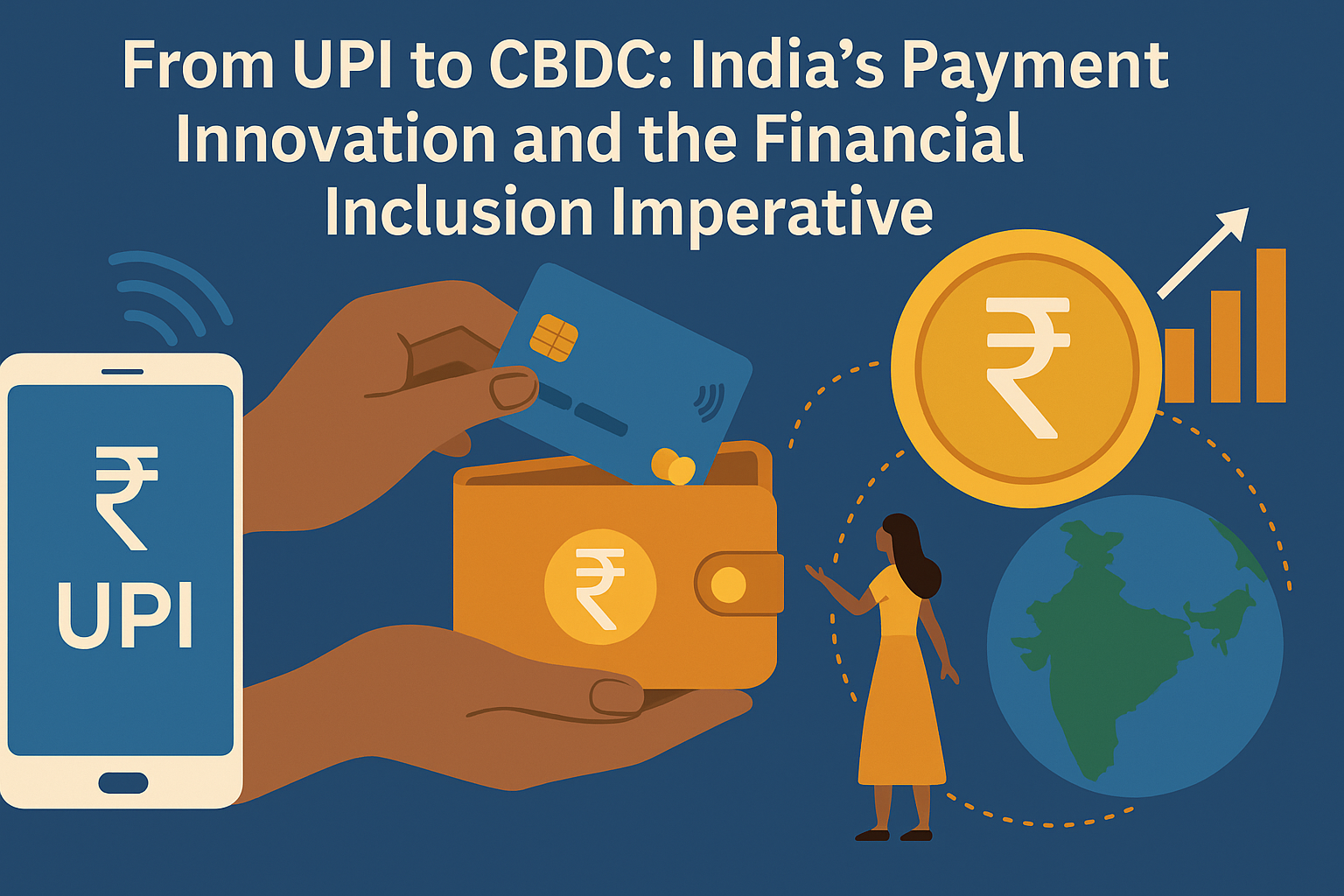
Digital India and IndiaStack enable inclusive access to governance and financial services.
-
The National Education Policy 2020 emphasizes human capital development for the knowledge economy.
-
Mission LiFE focuses on sustainable lifestyles aligned with climate goals.
-
The Make in India and Atmanirbhar Bharat initiatives boost domestic manufacturing and reduce import dependence.
-
Articles 38 and 39 of the Constitution direct the state to promote social and economic justice.
-
The recently proposed Semiconductor Mission and AI Framework aim to strengthen India’s technological sovereignty.
Challenges and Issues
-
Economic Inequality: Despite high GDP growth, income and wealth disparities persist, particularly in rural and informal sectors.
-
Employment Generation: Automation and global slowdown have limited job creation in manufacturing and services.
-
Climate Change: Extreme weather and resource scarcity threaten agriculture and energy security.
-
Geopolitical Complexity: Balancing relations between major powers while safeguarding national interests is a constant challenge.
-
Governance and Institutional Reform: Bureaucratic inefficiency and fiscal imbalances slow down the pace of implementation.
-
Social Cohesion: Regional disparities, migration, and digital divides can weaken the inclusivity of growth.
Way Forward
India’s strategy should combine reform, innovation, and resilience. Economic policies must focus on high-value manufacturing and digital infrastructure expansion. Investment in human capital through education, skilling, and healthcare is essential. The governance model should ensure cooperative federalism, transparent institutions, and policy stability. Climate goals can be pursued through renewable energy scaling, sustainable urban planning, and green finance mobilization. On the international front, India must strengthen South-South cooperation and leverage multilateral platforms for equitable global governance.
Significance for Exams
For Prelims
-
G20 Presidency Year – 2023
-
National Hydrogen Mission launched – 2021
-
Mission LiFE launched during COP27
-
National Education Policy Year – 2020
-
PLI Scheme covers 14 sectors
-
PM Gati Shakti launched – 2021
-
India’s GDP rank – fifth globally as per IMF 2025 estimate
-
Article 38 relates to Directive Principles of State Policy
For Mains
-
Discuss India’s economic resilience amid global uncertainty.
-
Examine the role of technology missions in India’s sustainable growth strategy.
-
Analyze the challenges of balancing climate action with development needs.
-
Evaluate India’s foreign policy approach in a multipolar world.
-
Suggest policy measures to bridge regional development disparities.
For Interview
-
India’s growth must be both inclusive and sustainable.
-
Technology is not a substitute for governance but a tool for good governance.
-
Climate responsibility and economic ambition can coexist through innovation.
-
India’s soft power and diplomacy are key assets in the global arena.
In Short
India stands at an inflection point in 2025. The direction it takes will depend on how effectively it balances economic ambition with social justice, technological progress with sustainability, and national interest with global responsibility.

Comments (0)
Leave a Comment