
Introduction
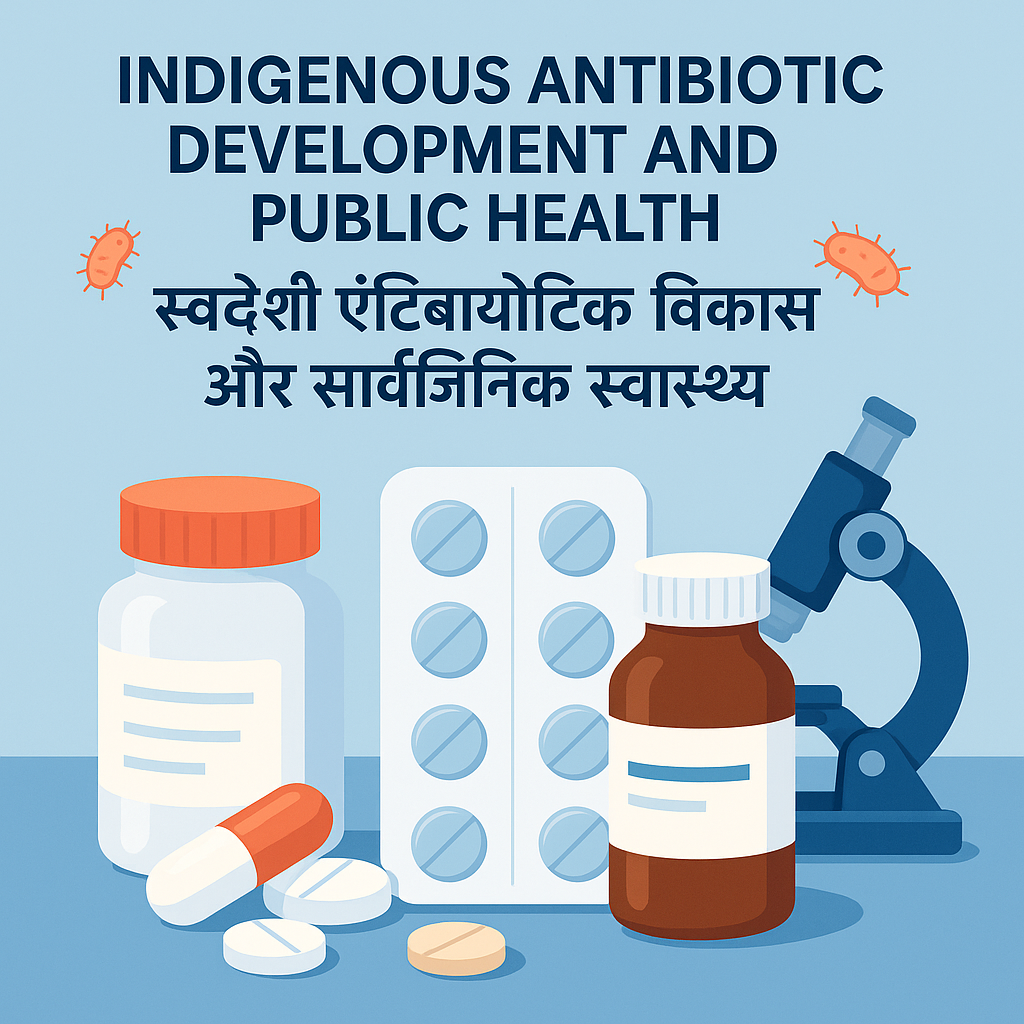
The rise of antibiotic resistance is one of the greatest challenges to modern medicine and public health. India, as one of the world’s largest consumers and producers of antibiotics, faces the dual challenge of ensuring access to life-saving drugs while combating antimicrobial resistance. In this context, the development of indigenous antibiotics assumes both strategic and health significance. It aligns with the national goals of self-reliance under the Atmanirbhar Bharat initiative and the constitutional vision of promoting public health under Article 47. Indigenous innovation in antibiotics is not merely a matter of scientific advancement but also a public health necessity to safeguard the population against drug-resistant infections.
Background and Context
Antibiotics revolutionized global healthcare in the twentieth century. However, overuse and misuse of these drugs have led to the emergence of antimicrobial resistance (AMR). In India, widespread availability of antibiotics without prescription, self-medication, and inadequate awareness have accelerated this trend. Historically, India has depended on imported Active Pharmaceutical Ingredients (APIs) and foreign-developed antibiotic molecules. To address this dependency, the government has promoted indigenous pharmaceutical research through initiatives like the Production Linked Incentive (PLI) scheme for bulk drugs and the establishment of the National Institute of Pharmaceutical Education and Research (NIPER).
The global concern around AMR prompted India to release the National Action Plan on Antimicrobial Resistance (2017–2021), which focused on research, surveillance, and awareness. Indigenous antibiotic development forms a crucial pillar of this strategy, aiming to reduce import dependency and create new molecules suited to India’s disease profile and microbial ecosystem.
Current Scenario
India’s pharmaceutical industry ranks third globally by volume, yet research in new antibiotic molecules remains limited. Most antibiotics used in India are generics developed decades ago. The Indian Council of Medical Research (ICMR) and Department of Biotechnology (DBT) have started collaborative programs to promote antimicrobial innovation. In 2024, ICMR initiated partnerships with biotech startups to develop narrow-spectrum antibiotics effective against resistant bacteria like Klebsiella and E. coli.
Several Indian companies are also entering antibiotic R&D, supported by government grants and international partnerships. Efforts are being made to establish genomic surveillance systems to monitor resistance patterns. Meanwhile, the Union Health Ministry has strengthened the National AMR Surveillance Network (NARS-Net) and introduced the “One Health” approach integrating human, animal, and environmental health data. These initiatives reflect a comprehensive framework for promoting indigenous research alongside public awareness and rational use of antibiotics.
Government Policies and Legal Provisions
-
The National Action Plan on AMR (2017–2021) provides a policy framework for research, surveillance, and regulation.
-
The Central Drugs Standard Control Organization (CDSCO) regulates antibiotic approval and sales.
-
The Schedule H1 category under the Drugs and Cosmetics Rules restricts over-the-counter sale of certain antibiotics.
-
The Production Linked Incentive (PLI) scheme for APIs promotes local manufacturing of essential bulk drugs.
-
The National Health Policy (2017) emphasizes strengthening pharmaceutical innovation and research infrastructure.
-
Article 47 of the Constitution directs the state to improve public health as a primary duty.
Challenges and Issues
-
Limited R&D investment – Pharmaceutical firms focus more on generic drugs due to high cost and low return in antibiotic research.
-
Dependence on imported raw materials – Many essential ingredients for antibiotics are sourced from abroad, affecting supply stability.
-
Regulatory delays – Lengthy approval and clinical trial processes hinder timely innovation.
-
Low public awareness – Overuse and misuse of antibiotics continue despite regulatory controls.
-
Weak surveillance – Inconsistent data on resistance patterns affects evidence-based policymaking.
-
Coordination gaps – Collaboration among health, veterinary, and environmental sectors under the One Health framework is still evolving.
Way Forward
-
Promote indigenous R&D through dedicated funding, research clusters, and academic-industry collaboration.
-
Strengthen public sector laboratories like ICMR and NIPER to focus on discovery of new antibiotic classes.
-
Encourage startups through incubation and technology transfer support from DBT and BIRAC.
-
Enhance surveillance by expanding NARS-Net to cover rural hospitals and private laboratories.
-
Implement awareness programs at community and school levels to reduce misuse of antibiotics.
-
Integrate AMR research with One Health by involving veterinary and agricultural sectors.
Significance for Exams
For Prelims:
-
National Action Plan on AMR launched in 2017.
-
CDSCO regulates drug safety and licensing in India.
-
Schedule H1 introduced in 2014 under Drugs and Cosmetics Rules.
-
ICMR and DBT lead antibiotic research collaborations.
-
NARS-Net monitors AMR in 35 medical institutions.
-
PLI Scheme for bulk drugs launched in 2020.
-
Article 47 – Duty of the state to improve public health.
-
NIPER established in 1998 for pharmaceutical research.
For Mains:
-
AMR is both a public health and national security challenge.
-
Indigenous R&D strengthens Atmanirbhar Bharat and reduces dependency.
-
Policy integration through One Health ensures holistic control.
-
Strengthened regulation and public awareness can reduce misuse.
-
Linking innovation with affordable healthcare ensures equity.
-
Case study – ICMR’s collaboration with startups to develop indigenous antibiotics in 2024.
For Interview:
-
Indigenous antibiotics represent self-reliance in healthcare innovation.
-
Public awareness and rational use are key to fighting AMR.
-
One Health approach connects human and environmental wellbeing.
-
Sustainable innovation must balance accessibility, affordability, and quality.
In Short
Indigenous antibiotic development is vital to protect public health, ensure self-reliance, and combat antimicrobial resistance. Strengthening R&D, enforcing regulations, and promoting awareness can transform India into a global leader in antibiotic innovation while safeguarding the health of its people.








Comments (0)
Leave a Comment