
Introduction
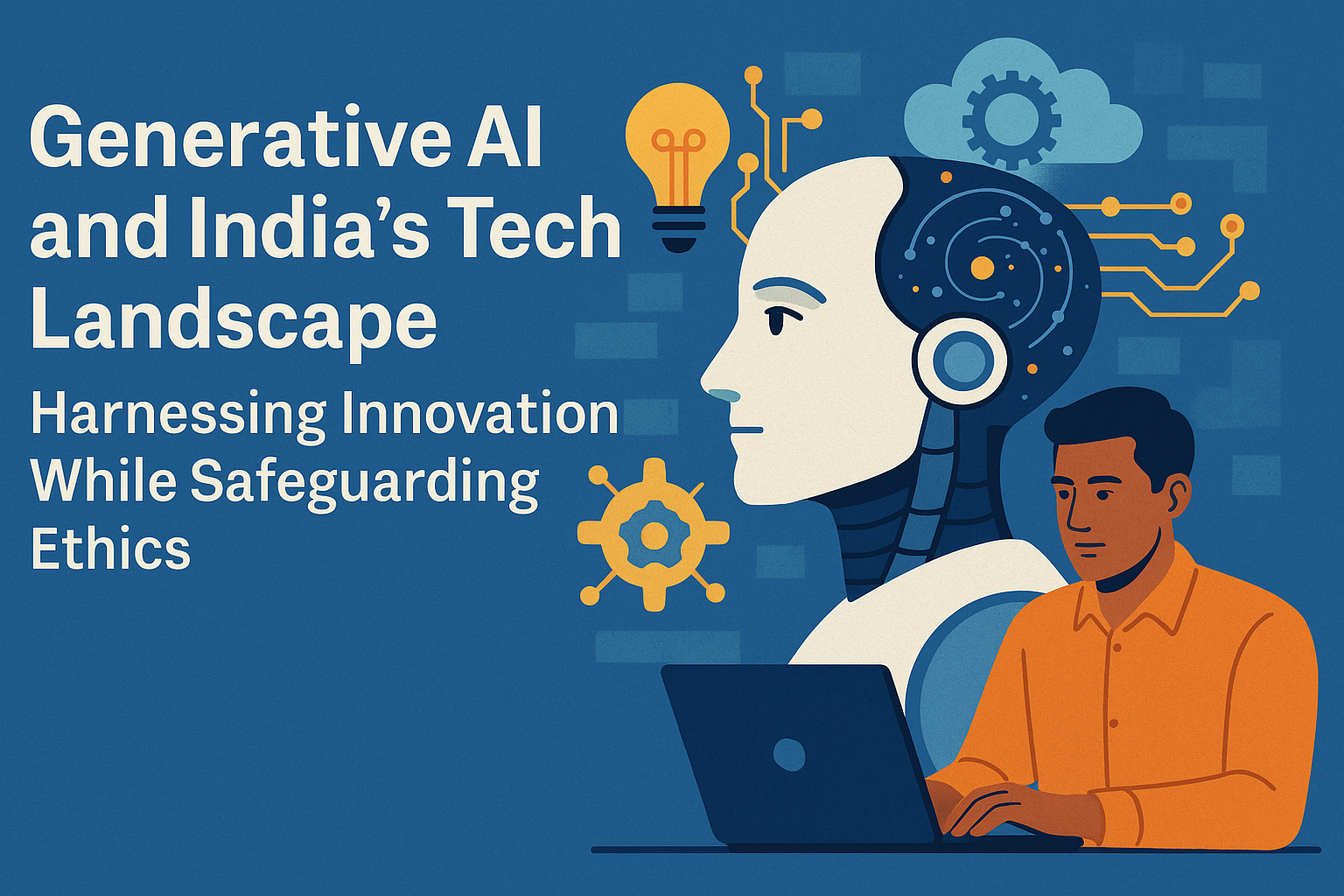
Generative Artificial Intelligence (AI) represents a transformational paradigm within India’s evolving digital landscape. Defined broadly, generative AI refers to algorithms capable of creating new content in forms such as text, image, audio, or video, autonomously learning from vast datasets. The issue of harnessing innovation while safeguarding ethics is of immediate relevance to India’s constitutional vision of justice, equality, and development. As India pushes to become a trillion-dollar digital economy and an inclusive technology leader, generative AI’s promises and pitfalls must be weighed in the context of citizen rights, social inclusion, and democratic values.
Background & Context
India’s digital transformation follows decades of policy evolution—starting from the National Informatics Centre (NIC) in the 1970s, the establishment of the Ministry of Electronics and Information Technology, to landmark initiatives such as Digital India and Startup India. Since 2017, AI development has been thrust forward through NITI Aayog-led roadmaps, ‘AI for All’ campaigns, and policies aiming for economic growth and digital inclusion. Historically, India’s focus has aimed at leveraging tech for mass empowerment. Generative AI, as a distinct advancement, uses models like GANs and Large Language Models (LLMs) capable of producing creative outputs, but also synthetic media and deepfakes, warranting fresh ethical scrutiny.
Current Scenario
India is witnessing a surge in generative AI adoption among startups and established technology firms. According to recent surveys, around 74% of AI-focused startups in India have adopted generative AI, with a majority founded post-2021. A September 2025 IPSOS survey found that more than 71% of Indians express positive attitudes toward AI products. Generative AI is enabling breakthroughs in sectors such as healthcare (medical imaging analysis), governance (automated grievance redressal), agriculture (crop analytics), and education (virtual tutors). However, the creation of synthetic content and deepfakes poses challenges to privacy, authenticity, and trust. Indian newspapers and portals regularly highlight both opportunities and concerns, particularly in relation to job disruption, misinformation, and algorithmic bias.
Government Policies & Legal Provisions
India’s regulatory response includes the Personal Data Protection Bill and draft regulations focusing on robust data governance. NITI Aayog and the Ministry of Electronics & IT are working toward framing a comprehensive AI governance strategy that balances innovation with ethical oversight. The Responsible AI for Social Empowerment (RAISE) initiative, launched in 2020, aims to establish ethical AI deployment standards for social inclusion. Key legal frameworks include the Information Technology Act, 2000 (with amendments), and constitutional anchors such as Article 21 (Right to Privacy, as interpreted by the Supreme Court), and Article 51A (promotion of scientific temper). India also participates in global forums to define responsible AI norms and actively collaborates in shaping international AI governance.
Challenges / Issues
-
Data Privacy and Protection: Generative AI models rely on extensive datasets, raising risks of unauthorized data use and breaches, particularly amidst weak enforcement of data protection laws.
-
Bias and Fairness: Algorithms can inherit social, cultural, or linguistic biases from training data, possibly aggravating inequality or misrepresentation.
-
Deepfakes and Misinformation: AI-generated fake content threatens public trust, potentially impacting elections, integrity of information, and social harmony.
-
Intellectual Property Rights: The use of copyrighted material for AI training raises legal and ethical dilemmas, currently debated in courts and policy circles.
-
Infrastructure and Digital Divide: Advanced AI development requires accessible computing resources and reliable internet, still lagging in rural and underserved regions.
-
Talent and Skilling: India faces shortages in skilled AI professionals, necessitating investments in education, research, and human resource development.
-
Regulation and Oversight: The tech innovation pace often outstrips legal frameworks, creating gaps in accountability, transparency, and enforcement.
Way Forward
-
Strengthening Data Governance: Enacting and enforcing comprehensive data protection legislation ensuring transparency, consent, and accountability in AI systems.
-
Promoting Inclusive AI: Developing AI models that represent India’s linguistic, cultural, and socio-economic diversity, reducing bias and enhancing accessibility.
-
Expanding Public Awareness: Initiatives aimed at digital literacy, responsible AI usage, and public engagement on ethical issues.
-
Boosting Infrastructure and Skilling: Investing in cloud and computing infrastructure, fostering research ecosystems, and integrating AI in higher education curricula.
-
Regulatory Sandboxing: Government-led pilot programs to test and refine AI frameworks before mass deployment, facilitating innovation with safe experimentation.
-
International Collaboration: Active engagement in shaping global AI standards, sharing best practices, and learning from international regulatory models such as the US, Japan, and EU.
Significance for Exams
For Prelims:
-
2017: NITI Aayog released the National Strategy for AI.
-
2020: India hosted RAISE 2020 on Responsible AI.
-
Personal Data Protection Bill (latest draft, 2023).
-
Ministry of Electronics and IT (MeitY): Nodal agency for AI.
-
GANs (Generative Adversarial Networks) and LLMs (Large Language Models): Technical terms.
-
Article 21 (Right to Privacy).
-
IT Act, 2000: Principal legal framework for digital technology.
-
Global Partnership on AI (GPAI): India’s role.
For Mains:
-
Case study: AI-driven virtual tutors in Indian schools for digital inclusion.
-
Debate: Balancing innovation and risk in AI-enabled healthcare diagnostics.
-
Example: Deepfake incidents and regulatory responses in India.
-
Analysis: Digital divide implications for generative AI deployment.
-
Policy: NITI Aayog’s consultative approach to AI ethics.
For Interview:
-
Generative AI offers vast economic, governance, and social opportunities but requires robust ethical safeguards.
-
India’s future in AI hinges on balancing innovation with inclusivity, transparency, and accountability.
-
International collaboration will be seminal for framing adaptable, responsible AI frameworks.
In Short
Generative AI stands at the crossroads of innovation and ethical responsibility in India. Effective governance, inclusive policy, and stakeholder engagement are essential to ensure AI is harnessed for public good while protecting rights, trust, and social harmony.









Comments (0)
Leave a Comment